 Türkçe
Assembly Fixtures | Industrial Fixture Systems
Industrial Assembly Fixtures for Accurate and Repeatable Production
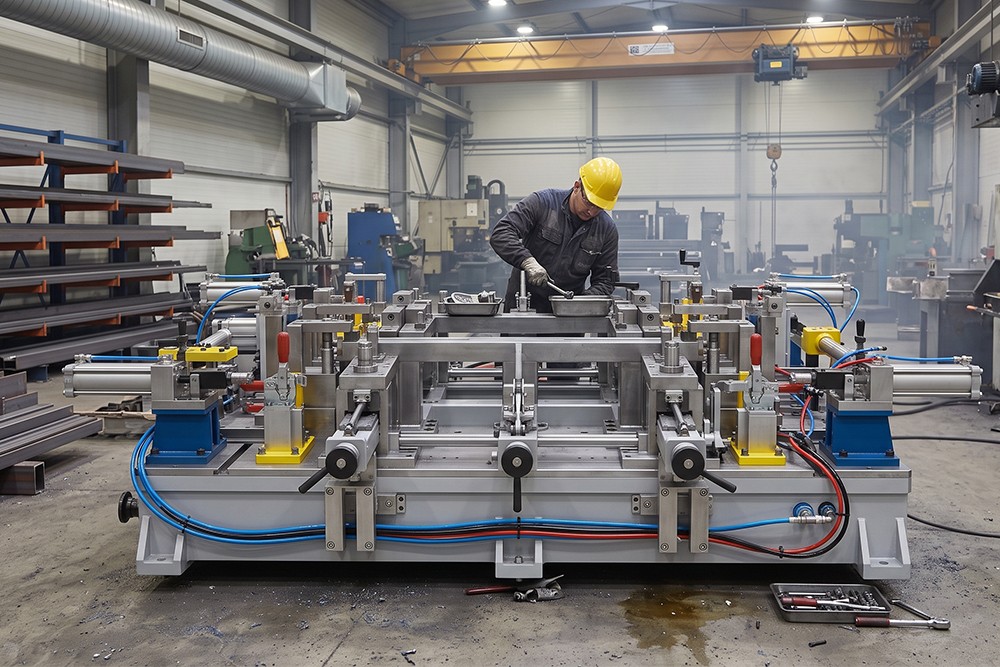
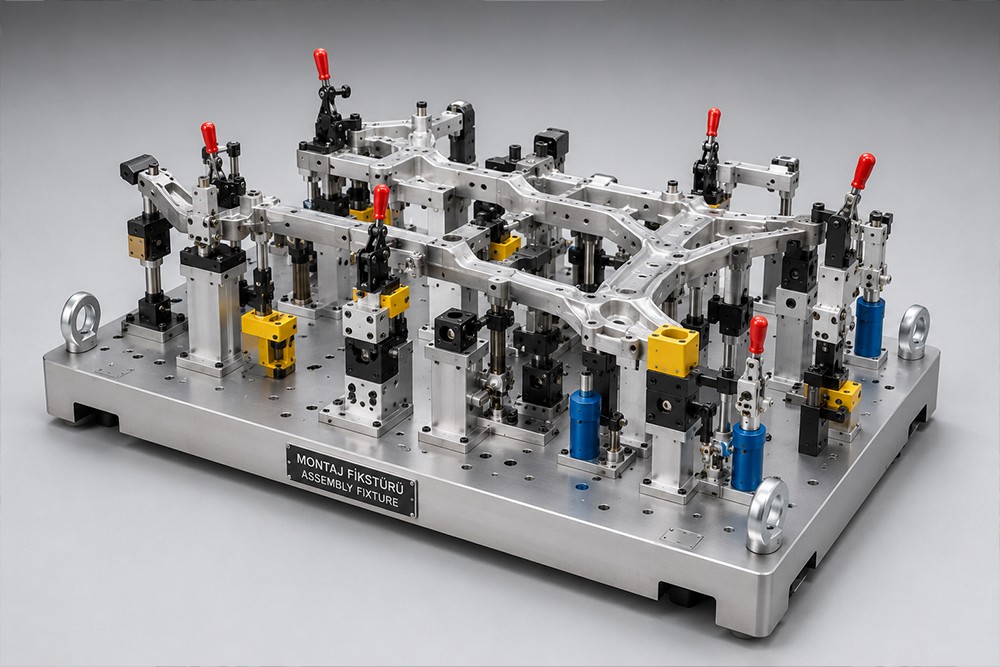
Assembly fixtures are production auxiliary systems used to position parts against defined datums, secure them safely and join them in the same geometric arrangement during every cycle. They reduce operator dependency, improve cycle organization and help maintain dimensional consistency in serial production.
Each system is engineered specifically according to part geometry, tolerances, assembly sequence, production volume, datum surfaces, clamping points, ergonomics, robot access and sensor requirements.
What Is an Assembly Fixture?
An assembly fixture is production equipment that positions one or more parts against defined datums, secures them and keeps them stable throughout the assembly operation.
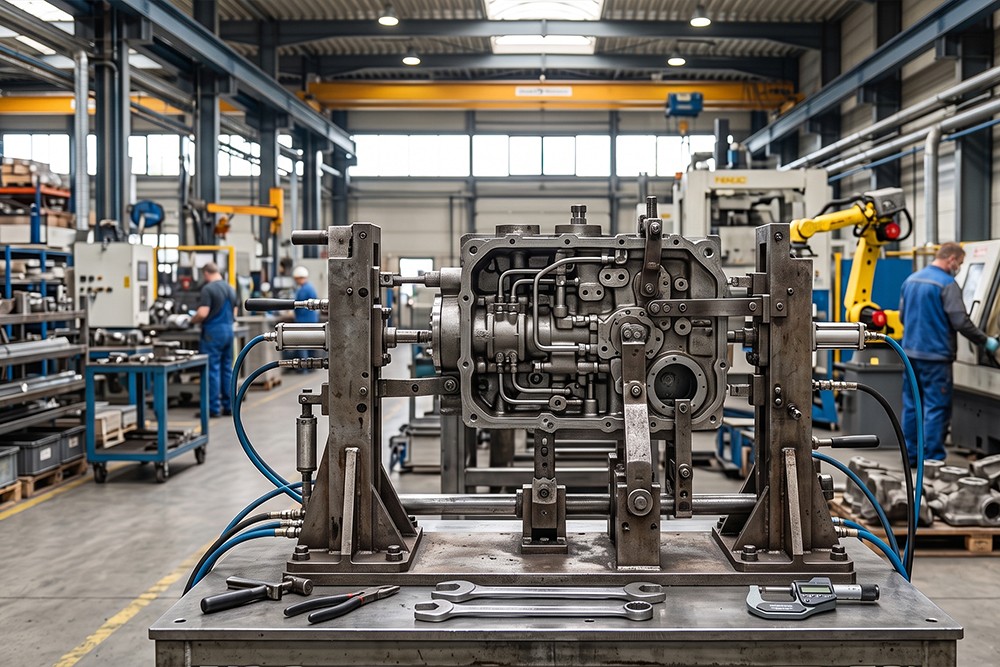
Depending on project requirements, the system may include:
- Steel-profile or plate supporting frame
- Locating pins and stops
- Mechanical, pneumatic or hydraulic clamps
- Quick-action clamps
- Adjustable supports and pressure pads
- Slides and channel systems
- Rotary or tilting mechanisms
- Part-presence and position sensors
- Poka-yoke components
- Modular and removable connections
Advantages of Assembly Fixtures
Provide Accurate Positioning
Ensure that parts locate against the same datums in every cycle and help limit dimensional variation.
Improve Assembly Repeatability
Standardize loading and clamping sequences to support more consistent serial-production results.
Reduce Cycle Time
Quick clamping, controlled loading and easy part removal help shorten assembly operations.
Reduce Operator Dependency
Defined part orientation, position and clamping sequence reduce differences between operators.
Help Prevent Incorrect Assembly
Poka-yoke details, pins, stops and sensors reduce the risk of incorrect orientation, missing parts or improper placement.
Offer a Modular and Upgradeable Structure
Replaceable modules can be added for new product variants or process changes.
Types of Assembly Fixtures
Manual Assembly Fixtures
Prepared with mechanical stops, pins and quick-action clamps operated by personnel.
Pneumatic Assembly Fixtures
Use pneumatic cylinders and valve systems for controlled and repeatable clamping at higher cycle speeds.
Hydraulic Assembly Fixtures
Applied to large or heavy components requiring higher clamping forces.
Robotic Assembly Fixtures
Designed according to robot access, sensors, part feeding and automation scenarios.
Rotary and Tilting Fixtures
Use manual, pneumatic or motorized mechanisms to provide access to different surfaces of the part.
Modular and Multi-Variant Fixtures
Allow different parts from the same product family to be assembled on one system using replaceable modules.
Key Design Considerations
- Part dimensions and geometry
- Technical tolerances
- Primary and secondary datum surfaces
- Assembly sequence
- Part loading and unloading direction
- Clamping points and forces
- Operator and robot access
- Cycle-time target
- Sensor and poka-yoke requirements
- Ergonomics and occupational safety
- Modularity and product variants
- Maintenance and adjustment access
Application Areas
- Automotive and supplier industries
- White-goods production
- Machinery and equipment manufacturing
- Metalworking and sheet-metal assembly
- Plastic and rubber component assembly
- Electronic and electromechanical assembly
- Defense and aerospace
- Robotics and automation lines
- Prototype and sample production
- Quality control and process validation
Our Production Process
Each project is evaluated individually according to part geometry, assembly method and production scenario.
1. Requirements and Technical Data Analysis
Part drawings, 3D models, tolerances, assembly sequence, production volume, cycle time and quality criteria are evaluated.
2. Datum and System Design
Locating pins, stops, clamping points, operator or robot access, sensors and error-proofing details are determined.
3. Technical Engineering and Manufacturing
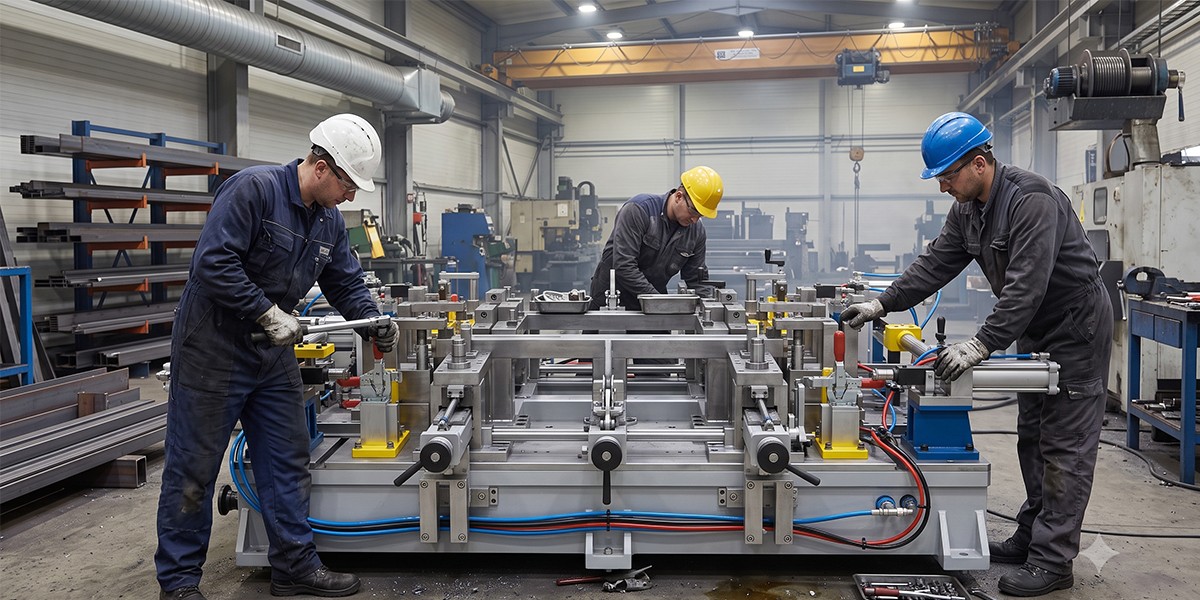
The supporting frame, machined plates, pins, bushings, stops and custom connections are produced according to technical drawings.
4. Assembly and Surface Treatment
Components are assembled accurately, and paint, coating, black oxide or corrosion protection is applied where required.
5. Dimensional, Functional and Repeatability Inspection
Datum points, clamping movements, sensors, part loading and dimensional stability over repeated cycles are checked.
6. Trial Production and Handover
Trial assembly is completed with actual or sample parts, final adjustments are made and the system is handed over ready for use.
Modification and Development of Existing Assembly Fixtures
Product changes, new variants, wear, clamping problems, dimensional variation or capacity increases may require existing fixtures to be modified.
Following a technical inspection, the following works may be carried out:
- Renewal of locating pins and stops
- Replacement of worn bushings and supports
- Modification of clamping elements
- Conversion from manual to pneumatic or hydraulic clamping
- Addition of sensors and poka-yoke
- Addition of modules for new product variants
- Reinforcement of frames and supporting plates
- Improvement of robot and operator access
- Dimensional adjustment and calibration
Material, Surface and Equipment Options
Materials and equipment are selected according to accuracy requirements, cycle quantity, process type and operating environment.
Carbon-Steel Profiles and Plates
Provide durable and cost-effective solutions for supporting frames and primary structures.
Machined Tool Steels
Used for locating pins, bushings, stops and precision components exposed to wear.
Aluminum Plates and Profiles
Can be considered where low weight, easy machining and fast modification are required.
Stainless Steel
Can be used in special projects requiring hygiene, humidity resistance or high corrosion protection.
Pneumatic and Hydraulic Clamping Components
Preferred where high cycle speed or controlled clamping force is required.
Sensors and Control Equipment
Part-presence sensors, position sensors, switches and error-proofing components can be integrated.
Why Nevas Çelik?
Projects are not limited to standard fixture structures; they are prepared according to actual part geometry, tolerances, assembly sequence, cycle time and operator or robot access.
Technical design, steel fabrication, precision machining, assembly, inspection and trial processes are managed within a single project. Mechanical, pneumatic, sensor-equipped and modular modifications can also be carried out on existing assembly fixtures.
Information Required for a Quotation
- 2D technical drawing or 3D model of the part
- Part dimensions and tolerances
- Daily or annual production quantity
- Assembly sequence
- Manual, pneumatic or hydraulic clamping preference
- Operator or robot-use information
- Cycle-time target
- Critical dimensions to be inspected
- Sensor and poka-yoke requirements
- Machine or production-line information
- Fixed, mobile or rotary fixture requirement
- Photographs and dimensions for existing-fixture modification
Frequently Asked Questions
Are assembly fixtures manufactured in standard dimensions?
No. They are designed specifically according to part geometry, tolerances, assembly sequence and production scenario.
Can pneumatic or hydraulic clamping be applied?
Yes. Pneumatic or hydraulic systems can be used according to cycle-time and clamping-force requirements.
Can fixtures be manufactured for robotic assembly lines?
Yes. Robot access, sensors, part feeding and automation communication can be considered in the design.
Can sensors and poka-yoke be added?
Yes. Control elements can be integrated to detect missing parts, incorrect orientation or improper positioning.
Can one fixture be used for multiple products?
Yes. Multi-variant systems can be prepared with replaceable modules and adjustable locating elements for suitable product families.
Can an existing assembly fixture be adapted to a new product?
Yes. Datum points, clamping locations, modules, sensors and supporting structures can be modified following technical inspection.
A Project-Specific Solution for Accurate and Repeatable Assembly
Technical assessment and project engineering can be provided for a fixture system suited to your part geometry, tolerances, cycle time and assembly process.
You can request a quotation for a new assembly fixture, modification of an existing system or pneumatic, sensor-equipped and modular upgrades by sharing your project information.