 Türkçe
Assembly Lines | Industrial Production and Assembly Systems
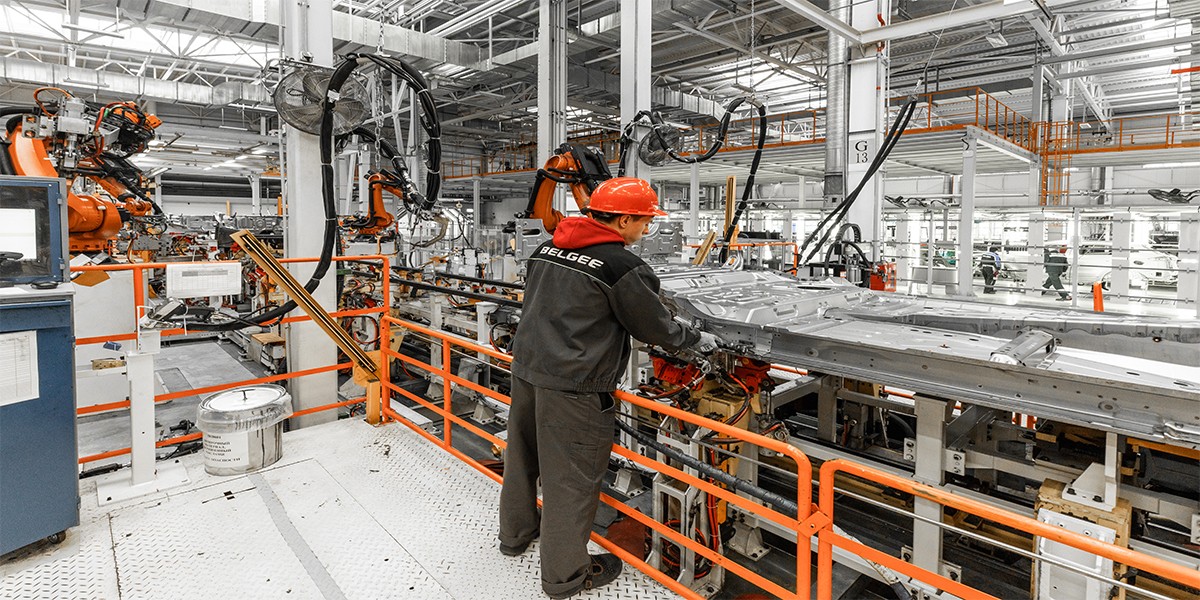
Industrial Assembly Lines for Organized, Efficient and Continuous Production
Assembly lines are integrated production systems that carry out part feeding, joining, fastening, testing, quality control, labeling and packaging operations in a defined process sequence. They organize workflow between stations, support cycle-time balancing and help maintain production quality.
Each line is engineered specifically according to product characteristics, process sequence, target cycle time, number of operators, ergonomic requirements, automation level and facility layout.
What Is an Industrial Assembly Line?
An industrial assembly line is a production system that allows a product or subassembly to be assembled, inspected and transferred through sequential workstations.
Depending on project requirements, the system may include:
- Steel supporting frames
- Operator workstations
- Belt, roller or chain conveyors
- Transfer tables
- Assembly fixtures
- Tool and material racks
- Lighting systems
- Electrical and pneumatic equipment
- Sensors and automation components
- Safety equipment
Advantages of Assembly Lines
Standardize Production Flow
Arrange assembly steps in a defined sequence so products progress in a controlled and repeatable manner.
Help Improve Cycle Times
Balance workload between stations and support the reduction of waiting, unnecessary movement and bottlenecks.
Support Operator Ergonomics
Appropriate working height, reach distance, lighting and material feeding reduce repetitive movement.
Integrate Quality Control into the Process
Enable testing, inspection and verification stations to be included in the line and support early error detection.
Organize Material Flow
Use part racks, containers, fixtures and transfer systems to deliver materials to the correct station.
Offer a Modular and Expandable Structure
Allow new stations and equipment to be added when products, capacity or processes change.
Types of Assembly Lines
Manual Assembly Lines
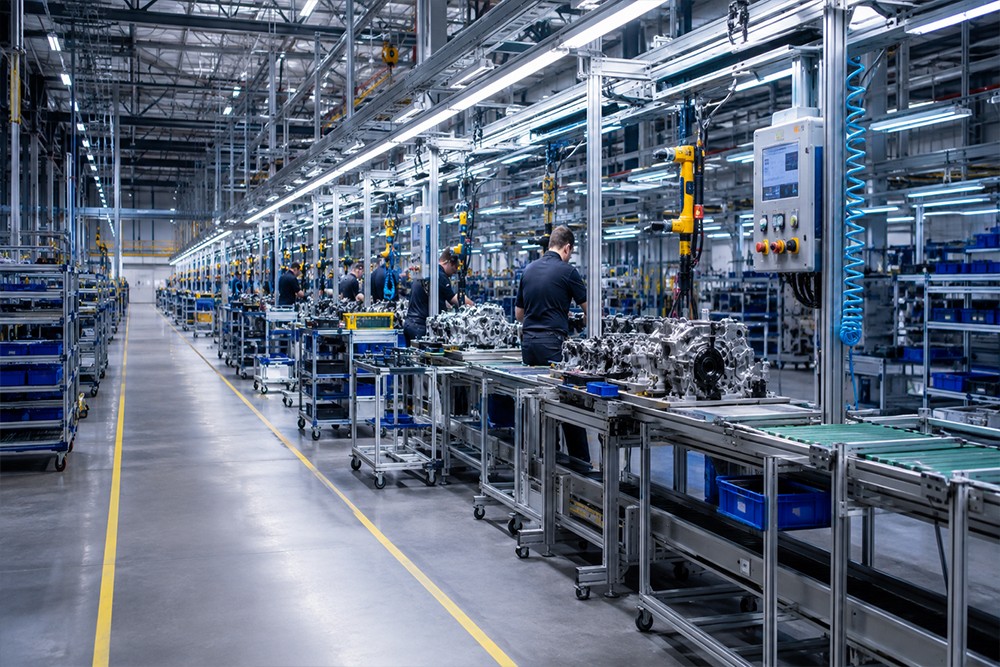
Systems in which assembly operations are performed by operators using ergonomic stations and controlled material flow.
Semi-Automatic Assembly Lines
Combine operator tasks with pneumatic, electrical or automated support equipment.
Fully Automatic Assembly Lines
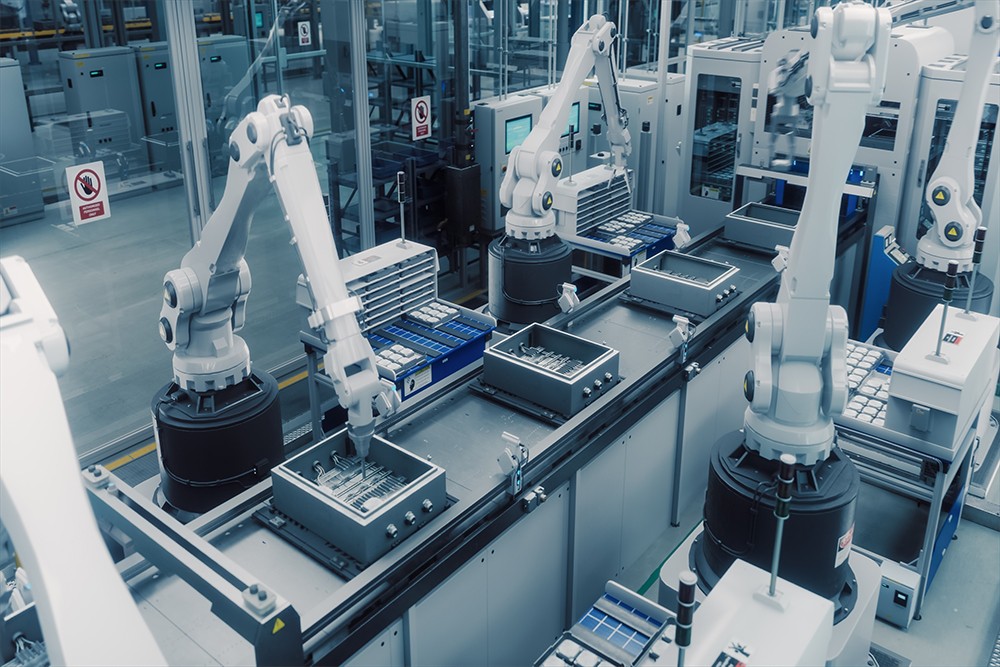
Use robots, sensors, automatic feeding and inspection systems for high repeatability.
Conveyor-Based Assembly Lines
Move products or fixtures between stations using belt, roller or chain conveyors.
Palletized and Fixtured Assembly Lines
Keep products securely positioned while they move between stations.
Testing and Quality-Control Lines
Integrate post-assembly testing, verification, labeling and packaging into the production flow.
Key Design Considerations
- Product and component dimensions
- Assembly-operation sequence
- Target cycle time
- Number of stations and workload balance
- Number of operators and ergonomics
- Material-feeding direction
- Conveyor and transfer-system selection
- Fixture and tool layout
- Testing and quality-control points
- Electrical and pneumatic requirements
- Sensor and automation level
- Maintenance, cleaning and safety access
Application Areas
- Automotive and supplier industries
- White-goods manufacturing
- Electrical and electronics assembly
- Metalworking facilities
- Plastics and rubber industries
- Food and packaging production
- Machinery manufacturing
- Robotics and automation
- Testing and quality-control processes
- Custom production and process lines
Our Production Process
Each project is evaluated individually according to product characteristics, target capacity and site conditions.
1. Requirements and Process Analysis
The product, assembly sequence, cycle time, number of operators, quality requirements and existing site conditions are evaluated.
2. Line Design
Station layout, conveyor and transfer modules, fixtures, racks, lighting, electrical-pneumatic infrastructure and automation points are determined.
3. Manufacturing
Steel frames, operator stations, racks, fixtures and mechanical components are manufactured according to project dimensions.
4. Integration and Inspection
Conveyors, sensors, pneumatic equipment, safety components and auxiliary systems are integrated into the line. Dimensional and functional checks are completed.
5. Testing and Process Validation
Product flow, station times, fixtures, test points, sensors and safety functions are tested under controlled conditions.
6. Shipment, Installation and Commissioning
The line is delivered, positioned, aligned and anchored; mechanical-electrical connections and trial production are completed.
Assembly Line Modification and Capacity Increase
Existing assembly lines may develop conveyor wear, station imbalance, insufficient fixtures, sensor faults, frame deformation or ergonomic problems. Product changes, higher capacity or new quality-control steps may also require modification.
Following a technical inspection, the following works may be carried out:
- Addition or removal of stations
- Line extension or shortening
- Conveyor and transfer-system modification
- Fixture and tool-connection renewal
- Ergonomic reconfiguration of operator stations
- Sensor and automation integration
- Addition of testing and quality-control points
- Frame and supporting-system reinforcement
- Electrical-pneumatic infrastructure renewal
- Surface-coating renewal
Material and Surface Options
Material and surface treatment are selected according to load capacity, hygiene requirements and operating environment.
Carbon-Steel Profiles
Form the main supporting frames and operator stations of the assembly line.
Plate and Bent-Sheet Components
Used for racks, enclosures, connections, fixtures and custom mounting elements.
Stainless Steel
Can be considered for food, chemical, wash-down and highly corrosive applications.
Aluminum Profile Systems
Can be used for lightweight, modular and easily modifiable stations and guards.
Electrostatic Powder Coating
Provides a durable surface suitable for indoor use and corporate colors.
Galvanizing and Industrial Coatings
Provide long-term protection in humid, outdoor or corrosive environments.
Why Nevas Çelik?
Projects are not limited to standard line layouts; they are prepared according to product geometry, process sequence, target cycle time, operator ergonomics and automation requirements.
Site survey, design, steel fabrication, workstation and conveyor integration, surface treatment, site installation and commissioning are managed within a single process. Maintenance, modification and capacity-increase work can also be carried out on existing assembly lines.
Information Required for a Quotation
- Product and subcomponent photographs
- Product dimensions and weight
- Assembly-operation sequence
- Target cycle time and capacity
- Number of operators
- Manual, semi-automatic or automatic system preference
- Conveyor and transfer requirements
- Fixture, testing and quality-control requirements
- Electrical and pneumatic infrastructure information
- Facility layout or technical drawing
- Installation and commissioning location
Frequently Asked Questions
Are assembly lines prepared in standard dimensions?
No. Line length, number of stations, working height and equipment layout are determined according to the product and process sequence.
What is the difference between manual and semi-automatic assembly lines?
Manual lines rely on operators for the main operations. Semi-automatic lines use automated equipment to support selected steps such as fastening, feeding, inspection or transfer.
Can conveyors be integrated into an assembly line?
Yes. Belt, roller, chain or palletized transfer systems can be selected according to the product and process requirements.
Can testing and quality-control stations be added?
Yes. Electrical, mechanical, visual or dimensional inspection points can be integrated into the assembly flow.
Can an existing assembly line be modified?
Yes. Stations, conveyors, fixtures, sensors, electrical-pneumatic infrastructure and safety components can be renewed or upgraded for higher capacity.
Do you provide installation and commissioning services?
Yes. Shipment, mechanical-electrical installation, alignment, testing, operator trials and trial production can be included in the project scope.
A Project-Specific Solution for Efficient and Continuous Production
Technical assessment and project engineering can be provided for an assembly line suited to product characteristics, process sequence and capacity targets.
You can request a quotation for a new line, modification of an existing system or capacity increase by sharing your project information.