 Türkçe
Gas Cylinder Cages | Industrial Cylinder Storage Systems
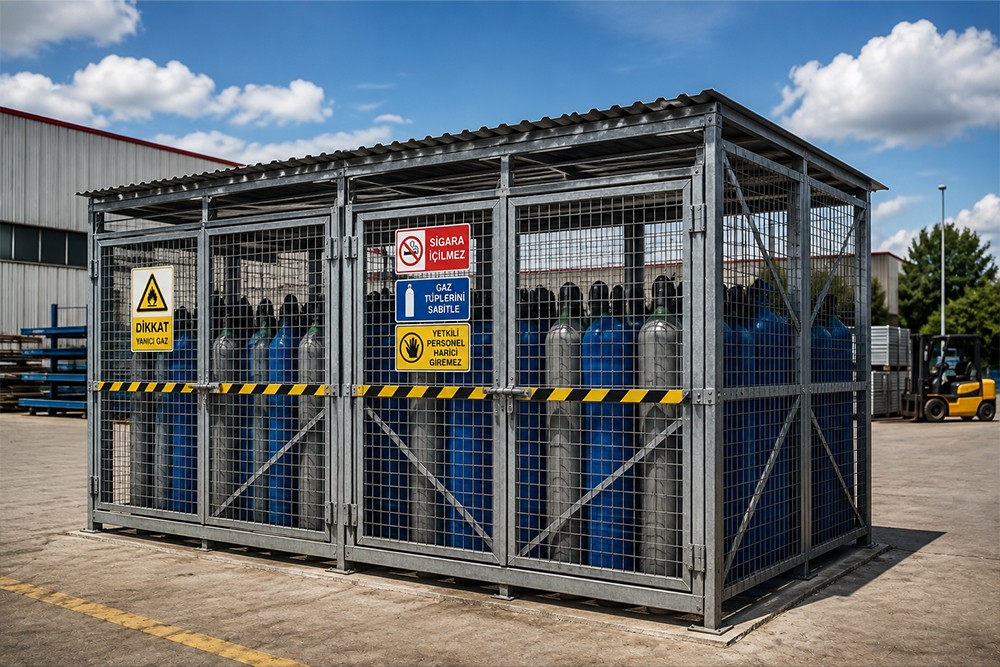
Industrial Gas Cylinder Cages for Safe and Controlled Storage
Gas cylinder cages are steel systems used to store oxygen, nitrogen, argon, carbon dioxide, LPG, acetylene and similar pressurized gas cylinders safely and systematically in factories and industrial facilities. They help reduce the risks of cylinders tipping, being struck, accessed without authorization or exposed to environmental conditions.
Each system is engineered specifically according to gas type, cylinder quantity and dimensions, full-empty separation, compatibility between gas classes, ventilation, door and restraint arrangement, indoor-outdoor conditions and site layout.
What Is an Industrial Gas Cylinder Cage?
An industrial gas cylinder cage is a steel safety structure used to keep pressurized gas cylinders upright, restrained and under controlled access.
Depending on project requirements, the system may include:
- Steel-profile supporting frame
- Wire-mesh or perforated-sheet cladding
- Single- or double-leaf lockable doors
- Chain, strap or clamp restraint systems
- Separate compartments for full and empty cylinders
- Storage zones separated by gas class
- Base plates and anchors
- Warning signs and color coding
- Roof and rain-protection elements
- Card-access or controlled-entry equipment
Advantages of Gas Cylinder Cages
Help Prevent Cylinders from Tipping
Chains, clamps or custom retainers keep cylinders upright and secured.
Separate Full and Empty Cylinders
Compartments, labels and color codes help separate full, empty and out-of-service cylinders.
Organize Gas Classes
Support suitable separation of flammable, oxidizing and inert gases.
Restrict Unauthorized Access
Lockable doors, card access or controlled-entry systems support authorized use only.
Provide Natural Ventilation
Wire mesh or ventilated cladding helps reduce the risk of gas accumulation.
Offer a Modular and Expandable Structure
New compartments and cage modules can be added when capacity or site layout changes.
Types of Gas Cylinder Cages
Single-Compartment Gas Cylinder Cages
Prepared for compact and controlled storage of cylinders from the same gas class.
Multi-Compartment Gas Cylinder Cages
Create independent sections for full-empty separation or different gas classes.
Controlled-Access Cages
Prepared with lockable doors, card access or authorized-entry systems.
Outdoor Gas Cylinder Cages
Manufactured with galvanizing, outdoor coating, roofing and suitable drainage details.
Forklift-Pocket Mobile Cages
Designed with reinforced bases and forklift pockets where controlled relocation is required.
Custom-Designed Gas Cylinder Cages
Engineered for confined spaces, between-column locations, high capacities or non-standard cylinder sizes.
Key Design Considerations
- Gas type and risk classification
- Cylinder diameter, height and total quantity
- Separation of full, empty and out-of-service cylinders
- Arrangement of flammable, oxidizing and inert gases
- Cylinder restraint method
- Cage height and number of compartments
- Door dimensions, swing direction and lock type
- Natural ventilation and open-area ratio
- Distance from ignition and heat sources
- Floor and anchoring conditions
- Forklift and pedestrian routes
- Outdoor, roof and drainage requirements
Application Areas
- Metalworking factories
- Automotive and supplier industries
- Machinery manufacturing plants
- Warehouses and logistics centers
- Food and beverage facilities
- Energy and technical facilities
- Welding and cutting areas
- Maintenance and service departments
- Laboratories and technical units
- Organized industrial zones
Our Production and Installation Process
Each project is evaluated individually according to gas types, cylinder capacity and site conditions.
1. Requirements Analysis and Site Survey
Gas types, cylinder quantities, dimensions, full-empty separation, floor conditions, routes, ignition sources and environmental conditions are evaluated.
2. Capacity and Layout Design
Cage dimensions, compartment quantity, doors, restraint systems, panel type, warnings and roof requirements are determined.
3. Technical Engineering and Manufacturing
Profile sections, panel dimensions, base plates, doors, locks and connections are manufactured according to technical drawings.
4. Surface Treatment and Quality Inspection
Electrostatic powder coating, wet paint or galvanizing is applied. Dimensions, welds, doors, locks and restraint points are inspected.
5. Shipment and Site Installation
Cage components are delivered and anchoring, alignment, panel, door and restraint installation are completed.
6. Final Inspection and Handover
Doors, locks, chains, compartments, warning signs and overall stability are checked before handover.
Modification and Expansion of Existing Gas Cylinder Cages
Changes in cylinder capacity, gas classes or facility layout may require existing cages to be enlarged or rearranged. Panel damage, corrosion, door failures, inadequate restraint and anchoring problems may also require modification.
Following a technical inspection, the following works may be carried out:
- Addition of new compartments and cage modules
- Replacement of panels and supporting profiles
- Renewal of door and lock systems
- Addition of chains, clamps and retainers
- Reorganization of full-empty separation
- Addition of roofs and rain protection
- Renewal of warning signs and color coding
- Reinforcement of base plates and anchors
- Surface-coating renewal
Material, Panel and Surface Options
Materials and surface systems are selected according to environmental conditions, corrosion risk, security requirements and usage intensity.
Steel-Profile Supporting Frame
Forms the primary structure and provides strength under heavy-duty conditions.
Wire-Mesh Panels
Combine natural ventilation, visibility and physical protection.
Perforated-Sheet Cladding
Can be used where controlled openings and more enclosed protection are required.
Electrostatic Powder and Wet Paint
Provide durable surfaces for indoor applications and projects requiring corporate colors.
Galvanized Coating
Provides long-term protection in outdoor, humid and corrosive environments.
Doors, Locks and Restraint Equipment
Single- or double-leaf doors, padlocks, cylinder locks, card access, chains, straps and clamps can be applied.
Why Nevas Çelik?
Projects are not limited to standard cage dimensions; they are prepared according to gas types, cylinder dimensions, capacity, compartmentation, restraint, ventilation and site conditions.
Site survey, technical design, steel fabrication, surface treatment and professional installation are managed within a single process. Panel, door, lock, restraint, anchoring and capacity modifications can also be carried out on existing cages.
Information Required for a Quotation
- Types of gases to be stored
- Number of full and empty cylinders
- Cylinder diameter and height
- Required number of compartments
- Indoor or outdoor use
- Lock and access-control requirements
- Preferred restraint method
- Roof and rain-protection requirements
- Color and warning-sign preferences
- Photographs of the application area
- Floor and installation conditions
- Installation location and work schedule
Frequently Asked Questions
Which materials are gas cylinder cages made from?
They are generally manufactured from steel-profile frames, wire-mesh or perforated-sheet cladding and reinforced connection components.
How are cylinders secured inside the cage?
Chains, clamps, straps or custom retainers keep cylinders upright and secure.
Can full and empty cylinders be separated?
Yes. Separate compartments, labels and color coding can separate full, empty and out-of-service cylinders.
Can different gas types be stored in the same cage?
Separate compartments can be designed according to gas properties and compatibility; independent cages are preferred for hazardous combinations.
Can cages be manufactured for outdoor use?
Yes. Galvanizing, outdoor coating, suitable roofing and drainage details can be applied.
Can an existing gas cylinder cage be modified?
Yes. Panels, doors, locks, chains, compartments, anchors and surface coatings can be modified.
A Project-Specific Solution for Safe Gas Cylinder Storage
Technical assessment and project engineering can be provided for a cage system suited to your gas types, cylinder capacity, site conditions and access requirements.
You can request a quotation for a new gas cylinder cage, expansion of an existing system or door, restraint and surface modifications by sharing your project information.