 Türkçe
Machine Perimeter Guarding Systems | Industrial Machine Safety
Industrial Machine Perimeter Guarding Systems for Safe Production Areas
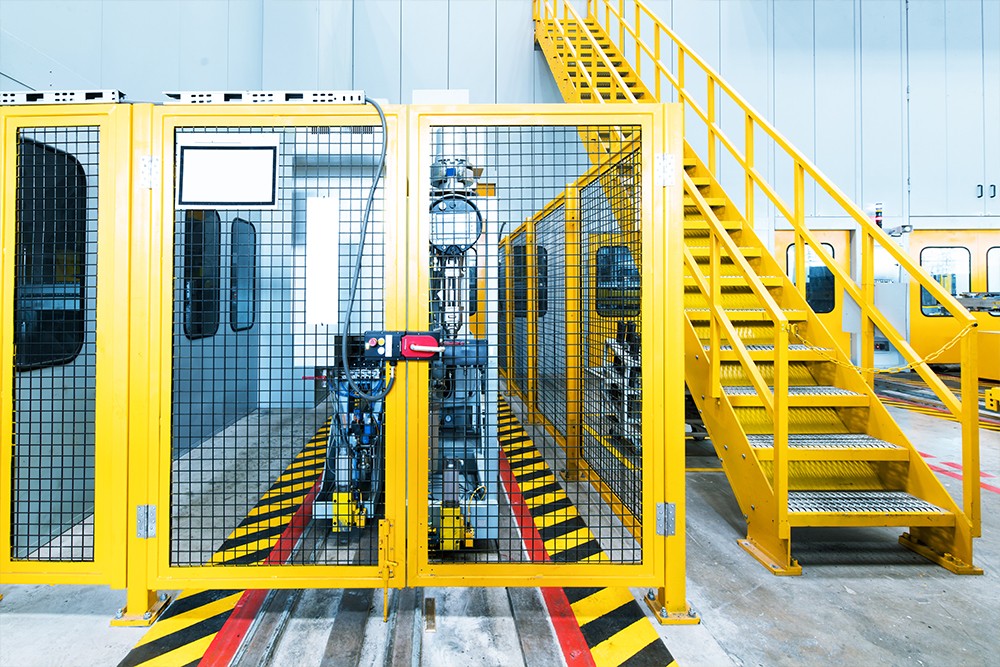
Machine perimeter guarding systems are modular steel safety structures that physically separate hazardous operating zones around robots, presses, conveyors, CNC machines and automation equipment. They help prevent uncontrolled access to moving parts, organize maintenance access and make safety boundaries clearly visible within the production area.
Each system is engineered specifically according to machine operating envelope, moving components, operator access, maintenance requirements, material entry and exit points and facility layout.
What Is a Machine Perimeter Guarding System?
A machine perimeter guarding system is a steel construction system that creates a physical safety boundary around production machines, robotic cells and automation equipment.
Depending on project requirements, the system may include:
- Steel supporting posts
- Mesh or sheet-metal panels
- Profile frames
- Lockable service and maintenance doors
- Safety switches and sensors
- Removable panel modules
- Cable and pipe passage details
- Base plates and anchoring elements
- Visual warning and color applications
Advantages of Machine Perimeter Guarding Systems
Restrict Access to Hazardous Machine Areas
Limit unintended approach to moving, rotating or high-speed equipment.
Control Unauthorized Access
Lockable and controlled doors allow only authorized personnel to enter the machine area.
Organize Maintenance and Service Operations
Service doors and removable panels allow maintenance teams to work in a controlled manner.
Make the Machine Operating Area Clearly Visible
Clearly defined boundaries help operators and visitors understand the site layout more easily.
Integrate with Safety Devices
Can work together with sensors, safety switches, electromechanical locks, light curtains and emergency-stop systems.
Offer a Modular and Expandable Structure
Panels, doors and posts can be rearranged when the machine or production-line layout changes.
Types of Machine Perimeter Guarding Systems
Mesh-Panel Machine Guards
Modular solutions that restrict physical access while maintaining visibility of the machine.
Profile-Frame Safety Cages
Manufactured with rigid profile frames for applications requiring higher strength and custom dimensions.
Sheet-Metal Machine Enclosures
Provide closed-surface protection in areas with flying parts, sparks, chips or liquid splash.
Robotic Cell Guarding Systems
Restrict robot operating envelopes and can integrate with sensor-equipped doors and automation safety systems.
Conveyor and Transfer-Line Guards
Limit access to hazardous areas around moving belts, chains, rollers and transfer points.
Systems with Lockable Service Doors
Provide controlled access for maintenance and adjustment using mechanical or electrical locking options.
Key Design Considerations
- Machine operating envelope
- Robot reach area
- Pinch and crushing points
- Safe approach distance
- Panel height and module spacing
- Service and maintenance access
- Material entry and exit points
- Door and interlocking system
- Visibility and operation monitoring
- Cable, pipe and utility passages
- Floor and anchoring structure
- Future modification requirements
Application Areas
- Robotic cells
- Press and die areas
- CNC and machining centers
- Conveyor and transfer lines
- Automation systems
- Packaging and assembly lines
- Automotive and supplier industries
- Metalworking facilities
- Food and packaging plants
- White-goods and electronics manufacturing
Our Production Process
Each project is evaluated individually according to machine risk, access requirements and site layout.
1. Technical Assessment and Site Survey
The machine operating envelope, moving parts, operator and maintenance access, material flow and floor conditions are evaluated on site.
2. System Design
Panel height, post spacing, door positions, interlocking system, material passages and anchoring details are determined. Technical drawings are prepared.
3. Manufacturing
Steel profiles, mesh or sheet-metal panels, doors and connection components are cut, machined and welded according to project dimensions.
4. Surface Treatment and Inspection
Electrostatic powder coating, galvanizing or protective coating is applied. Dimensions, welds, door movement and module compatibility are inspected.
5. Shipment and Site Installation
Guarding modules are delivered to the site, positioned according to the project, aligned and anchored to the floor.
6. Final Inspection and Commissioning
Doors, locks, sensors, access openings and system integrity are checked before handover.
Machine Perimeter Guarding Modification and Reinforcement
Existing systems may develop impact damage, loose connections, panel deformation, door failures or worn surface coatings over time.
Following a technical inspection, the following works may be carried out:
- Replacement of damaged panels or posts
- Door and lock-system renewal
- Anchor and connection reinforcement
- Addition of new service doors
- Sensor and safety-switch integration
- Guarding-line extension
- Material-passage modification
- Surface-coating renewal
Material and Surface Options
Material and surface treatment are selected according to risk level, visibility requirements, impact risk and operating environment.
Steel Profile Structure
Forms the main supporting structure of the guarding system. Profile section and wall thickness are selected according to application risk.
Mesh Panels
Maintain machine visibility while restricting physical access.
Sheet-Metal and Perforated Panels
Provide more enclosed protection in areas with flying parts, chips or liquid splash.
Transparent Panel Options
Can be used where the operation must be monitored safely from outside the guarded area.
Electrostatic Powder Coating
Provides a durable surface suitable for indoor use and corporate colors.
Galvanizing and Protective Coatings
Provide long-term protection in humid, semi-open or corrosive environments.
Why Nevas Çelik?
Projects are not limited to standard panel dimensions; they are prepared according to machine operating envelope, maintenance requirements and facility layout.
Site survey, design, steel fabrication, surface treatment, installation and safety-device integration are managed within a single process. Modular systems also allow adaptation to future machine and line changes.
Information Required for a Quotation
- Photographs of the machine and application area
- Machine dimensions and operating envelope
- Approximate guarding-line length
- Required panel height
- Door and maintenance-access requirements
- Material entry and exit points
- Sensor or interlocking expectations
- Floor structure and installation area
- Preferred panel type
- Layout or machine drawings, if available
Frequently Asked Questions
Are systems manufactured in standard dimensions?
No. They are engineered specifically according to machine dimensions, operating envelope, maintenance access and facility layout.
Can they be used for robotic cells?
Yes. Custom guarding systems can be developed according to robot reach, door position and automation safety requirements.
Which panel options are available?
Mesh, profile-frame, perforated sheet, solid sheet and project-specific transparent panel options can be used.
Can sensor-equipped safety doors be added?
Yes. Doors integrated with safety switches, electromechanical locks and control systems can be designed.
Can an existing system be expanded?
Yes. New panels, doors, sensors or guarding modules can be added according to the existing layout.
Do you provide installation and commissioning services?
Yes. Shipment, anchoring, module assembly, door adjustment, sensor inspection and final checks can be included in the project scope.
A Project-Specific Solution for Safe Production Areas
Technical assessment and project engineering can be provided for a machine perimeter guarding system suited to the machine operating envelope, maintenance requirements and site layout.
You can request a quotation for a new installation, an existing-system modification or safety-device integration by sharing your project information.