 Türkçe
Material Carts | Industrial Transport Solutions
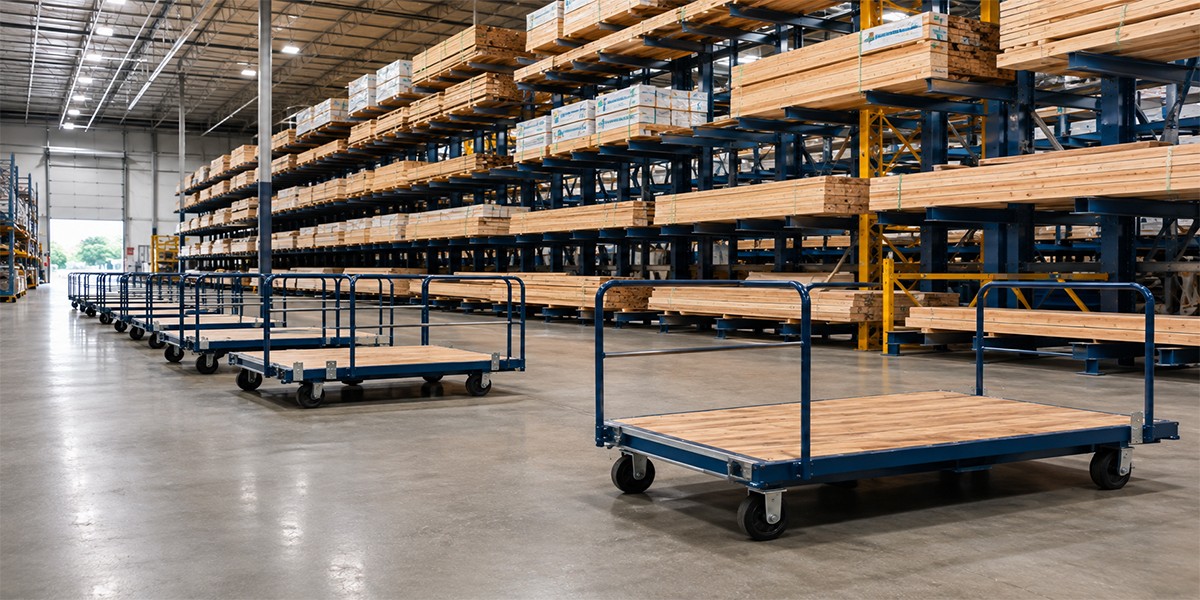
Industrial Material Carts for Safe and Organized Internal Logistics
Material carts are mobile steel systems used to move parts, semi-finished products, tools, crates, consumables and special equipment safely between factories, workshops, warehouses and production areas. They reduce manual handling, organize line-side feeding and support more controlled internal logistics.
Each system is engineered specifically according to product dimensions, weight, center of gravity, frequency of use, route conditions, floor structure and operator ergonomics.
What Is a Material Cart?
A material cart is industrial equipment that moves different loads in an organized, safe and controlled manner on a wheeled frame.
Depending on project requirements, the system may include:
- Steel-profile supporting frame
- Sheet-metal, shelved or enclosed body
- Drawers and carrying bins
- Custom cradles and separators
- Pushing and steering handles
- Fixed, swivel or braked wheels
- Load-fixing elements
- Forklift pockets
- Tow bars and tugger connections
- Modular bolted components
Advantages of Material Carts
Facilitate Internal Transport
Allow parts, equipment and semi-finished products to be moved between production areas in a controlled manner.
Support Operator Ergonomics
Suitable loading height and handle arrangement reduce unnecessary bending, lifting and carrying movements.
Organize Production Flow
Make material movement between line-side feeding, assembly, quality-control and dispatch points more systematic.
Reduce Part Damage
Custom cradles, separators and protective surfaces limit contact between parts during movement.
Improve Workplace Organization
Help prevent materials from being left in aisles or scattered on the floor.
Offer a Modular and Modifiable Structure
Shelves, drawers, bins, cradles and accessories can be rearranged according to changing needs.
Types of Material Carts
Shelved Material Carts
Used to carry boxes, crates, consumables and semi-finished products on multiple levels.
Drawer Tool and Parts Carts
Provide organized and lockable transport for hand tools, measuring equipment and small parts.
Line-Side Feeding Carts
Designed to deliver defined quantities of parts to assembly and production stations in sequence.
Long-Component Carts
Prepared with horizontal or vertical supports for pipes, profiles, shafts and similar long materials.
Custom-Cradle Parts Carts
Protect sensitive, painted or specially shaped parts from contact during transport.
Heavy-Duty and Towable Carts
Reinforced for high-weight equipment or serial transport with tugger systems.
Key Design Considerations
- Maximum total load and individual part weight
- Load dimensions and center of gravity
- Frame and body sections
- Shelf, drawer and cradle arrangement
- Wheel diameter, material and capacity
- Fixed, swivel and braked wheel layout
- Floor structure, slope, thresholds and surface irregularities
- Aisles, doors and turning areas
- Handle height and push-pull direction
- Load fixing and surface protection
- Forklift or tugger compatibility
- Corrosion and operating environment
Application Areas
- Automotive and supplier industries
- Metalworking facilities
- Plastic injection and die manufacturing
- Machinery manufacturing
- Production and assembly lines
- Warehouses and logistics centers
- Food and packaging facilities
- White-goods and electronics manufacturing
- Maintenance and quality-control areas
- Defense, energy and special projects
Our Production Process
Each project is evaluated individually according to load characteristics, route and operating scenario.
1. Requirements Analysis and Site Survey
Products, loads, frequency of use, aisles, doors, floor conditions, slopes and workstations are evaluated.
2. System Design
Body dimensions, frame sections, shelf or cradle arrangement, wheel layout, handle and safety accessories are determined.
3. Manufacturing
Steel profiles, sheets, shelves, drawers, separators and connection components are cut, bent, machined and welded according to project dimensions.
4. Surface Treatment and Quality Inspection
Electrostatic powder coating, wet paint, galvanizing or protective coating is applied. Dimensions, welds, body balance and connections are inspected.
5. Assembly and Functional Testing
Wheels, brakes, shelves, drawers, handles and safety elements are installed; movement, maneuverability, balance and loading compatibility are tested.
6. Shipment and Site Handover
The cart is delivered ready for use, and final site tests, adjustments and handover inspections are completed.
Modification and Reinforcement of Existing Material Carts
Intensive use, overloading, impact, poor floor conditions or unsuitable wheels may cause frame bending, weld cracks, wheel failures, handle deformation and surface damage.
Following a technical inspection, the following works may be carried out:
- Frame and body reinforcement
- Wheel and braking-system replacement
- Addition of shelves, drawers or bins
- Renewal of custom cradles and separators
- Handle modification
- Addition of forklift pockets or tow bars
- Weld repair
- Dimensional and capacity modification
- Surface-coating renewal
Material and Surface Options
Material and surface treatment are selected according to load capacity, load type and operating environment.
Carbon-Steel Profiles
Provide a durable and cost-effective solution for main frames and shelving structures.
Sheet and Bent-Metal Components
Used for work surfaces, bins, drawers, separators, covers and connection elements.
Stainless Steel
Can be considered for applications requiring hygiene, wash-down resistance or high corrosion protection.
Wheel Options
Polyurethane, rubber, polyamide or cast wheels can be selected according to load and floor conditions.
Electrostatic Powder and Wet Paint
Provide durable surfaces for indoor use and applications requiring specific chemical resistance.
Galvanized Coating
Provides long-term protection in humid, semi-open or highly corrosive environments.
Why Nevas Çelik?
Projects are not limited to standard cart dimensions; they are prepared according to actual loads, route conditions, operator ergonomics, wheel requirements and site layout.
Site survey, technical design, steel fabrication, surface treatment, accessory assembly and functional testing are managed within a single process. Reinforcement, wheel replacement, accessory addition and capacity modification can also be carried out on existing carts.
Information Required for a Quotation
- Photographs of products or parts to be transported
- Product dimensions and maximum total load
- Quantity to be carried on one cart
- Operating area and transport route
- Floor structure, thresholds and slopes
- Shelf, drawer, bin or custom-cradle requirements
- Wheel and brake expectations
- Handle, forklift-pocket or tow-bar requirements
- Preferred color and surface treatment
- Delivery and operating location
- Photographs, dimensions and damage information for modification projects
Frequently Asked Questions
How many kilograms can material carts carry?
Capacity is engineered according to frame section, wheel capacity, load distribution, body dimensions and floor conditions.
Are carts manufactured in standard dimensions?
No. The body, shelving, wheels and accessories are prepared specifically according to the material to be transported.
Can custom part cradles be manufactured?
Yes. Sheet-metal, profile, plastic, rubber or felt-supported cradles and separators can be produced according to part geometry.
Can braked wheels be used?
Yes. Fixed, swivel, braked or directional-lock wheel options can be applied according to use.
Can existing material carts be reinforced?
Yes. Frames, shelves, welds, wheels, handles and braking systems can be inspected and modified.
Can carts be connected to tugger systems?
Yes. Tow bars, rear connections and safety locks suitable for tugger systems can be added.
A Project-Specific Solution for Safe and Organized Internal Logistics
Technical assessment and project engineering can be provided for a material cart suited to the products, load capacity, route and operator use.
You can request a quotation for new production, reinforcement of an existing system or accessory integration by sharing your project information.