 Türkçe
Mold Carts | Industrial Mold Handling Solutions
Industrial Die Carts for Safe and Controlled Die Handling
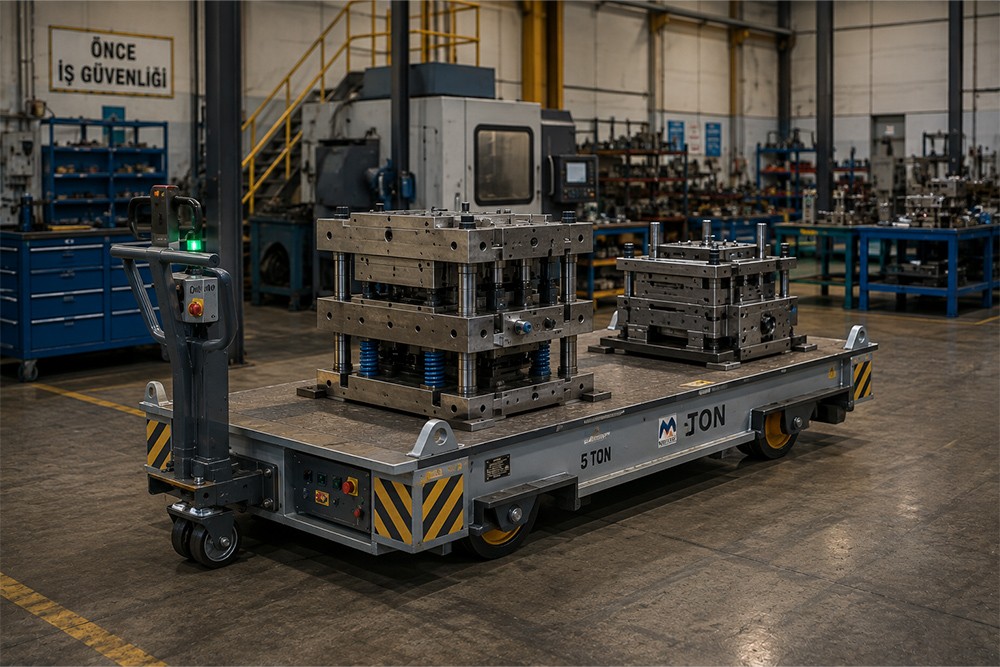
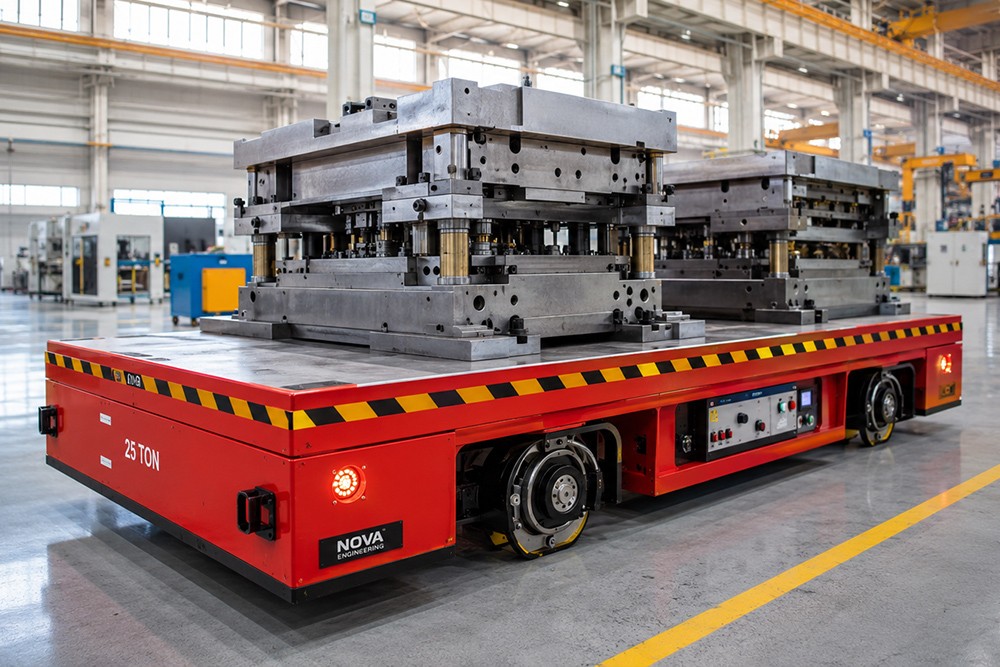
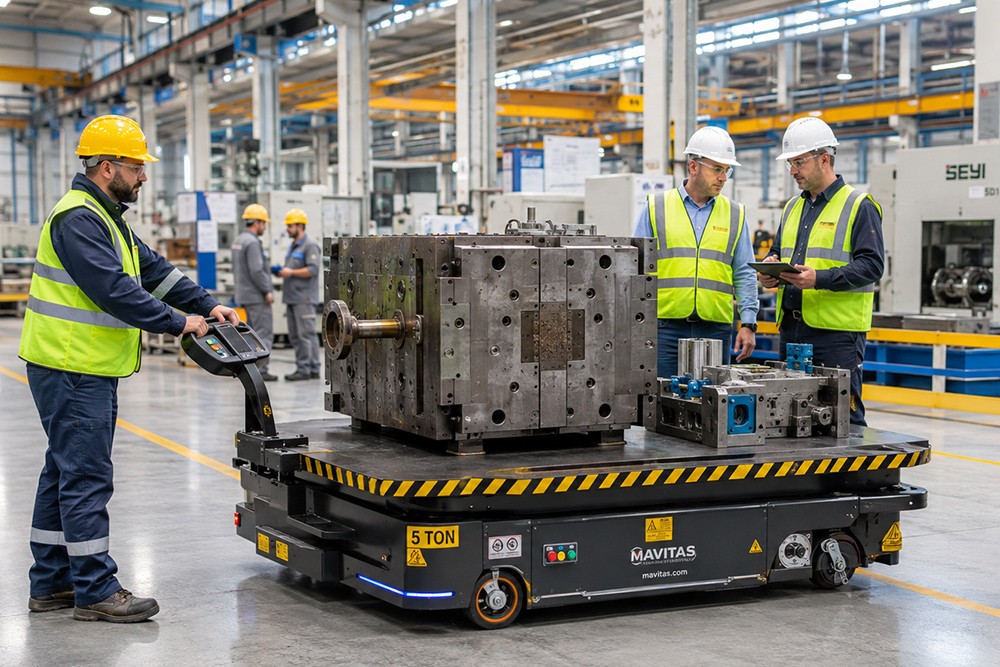
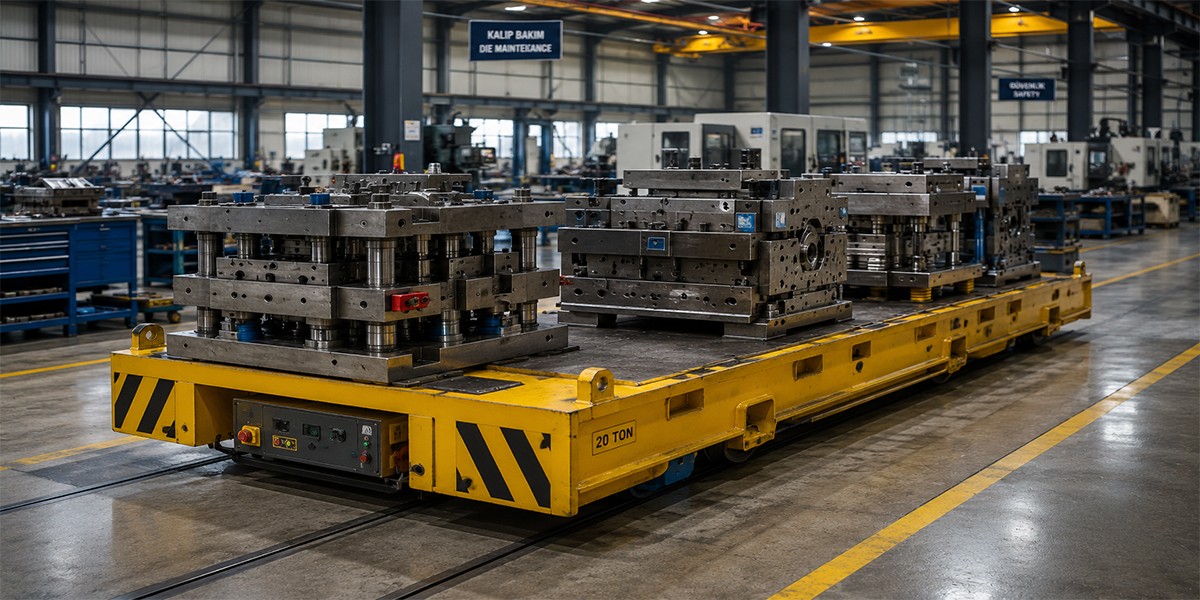
Die carts are industrial auxiliary equipment used to move heavy dies safely between presses, injection-molding machines, maintenance, preparation and storage areas. They support controlled transfer, help protect die surfaces, reduce operator intervention and organize die-change operations.
Each system is engineered specifically according to die weight, dimensions, base geometry, center of gravity, transfer route, floor conditions, machine height and handling method.
What Is a Die Cart?
A die cart is a steel-structured transfer unit used to move heavy production dies along a defined route in a controlled manner.
Depending on project requirements, the system may include:
- Welded steel-profile supporting frame
- Fixed or roller-top platform
- Heavy-duty wheels
- Braking and directional-locking systems
- Tow bar or push handles
- Forklift pockets
- Lifting lugs
- Mechanical stops
- Die-locking and restraint components
- Hydraulic lifting or height-adjustment system
Advantages of Die Carts
Move Heavy Dies Safely
Support balanced and controlled movement and help reduce tipping, sliding and collision risks.
Protect Die Surfaces
Suitable contact plates, rollers, supports and mechanical stops limit damage to precision-machined surfaces.
Organize Die-Change Time
A repeatable transfer arrangement supports more systematic preparation and die-change operations.
Reduce Operator Intervention
Roller platforms, towing systems, forklift connections or hydraulic assistance reduce manual force requirements.
Simplify Maintenance and Preparation
Allow dies to be moved safely to maintenance, cleaning, inspection and preparation areas.
Offer a Project-Specific and Upgradeable Structure
The cart can be reinforced, extended or rearranged when die weight, machine height or site layout changes.
Types of Die Carts
Fixed-Top Die Carts
Durable solutions in which the die is carried on a flat, reinforced platform.
Roller-Top Die Carts
Simplify horizontal transfer between the cart and a press, injection-molding machine, rack or maintenance bench.
Heavy-Duty Die Carts
Manufactured with reinforced frames, axles, wheels and connections for high-tonnage dies.
Forklift-Towable Die Carts
Prepared with suitable connections for controlled movement by forklift or towing vehicle.
Rail-Guided Die Carts
Provide directional stability on repeated transfer routes by moving along rails.
Hydraulic-Lift Die Carts
Provide controlled lifting and height adjustment to match machines, racks or workbenches.
Key Design Considerations
- Die weight and external dimensions
- Die base geometry
- Center of gravity and load distribution
- Platform dimensions and structural sections
- Wheel capacity and floor pressure
- Brakes, directional locks and safety stops
- Roller-transfer direction and platform height
- Forklift, towing or manual movement method
- Machine, rack and maintenance-bench elevations
- Route width, slopes and turning areas
- Floor flatness and surface conditions
- Die restraint and locking points
Application Areas
- Press and metal-forming lines
- Plastic injection-molding facilities
- Foundries and die-manufacturing plants
- Automotive and supplier industries
- White-goods manufacturing
- Rubber and plastics processing
- Die maintenance and preparation areas
- Tool rooms
- Die-storage systems
- Custom production and automation lines
Our Production Process
Each project is evaluated individually according to die load, transfer method and site conditions.
1. Requirements and Technical Data Analysis
Die dimensions, weight, center of gravity, base geometry, machine height, route and handling method are evaluated.
2. Capacity and System Design
Frame dimensions, structural sections, upper platform, wheels, rollers, brakes, towing and locking systems are determined.
3. Technical Engineering and Manufacturing
Steel profiles, plates, reinforcements, shafts, wheel connections and custom parts are cut, machined and welded according to technical drawings.
4. Surface Treatment and Quality Inspection
Blasting, primer, electrostatic powder coating, industrial wet paint or galvanizing is applied. Dimensions, welds, geometry and connections are inspected.
5. Functional and Load Testing
Wheel movement, brakes, roller platform, locking points, towing system and, where applicable, behavior under load are checked.
6. Shipment and Site Handover
The cart is delivered safely and handed over after checking site compatibility, operating height, route and transfer scenario.
Modification and Reinforcement of Existing Die Carts
Intensive use, overloading, impact, corrosion, wheel wear or the introduction of heavier dies may require existing carts to be modified.
Following a technical inspection, the following works may be carried out:
- Reinforcement of the frame and platform
- Wheel, axle and bearing replacement
- Addition of brakes and directional locks
- Conversion to a roller-top platform
- Addition of forklift pockets or tow bars
- Renewal of die-restraint points
- Addition or modification of hydraulic lifting
- Weld and connection repairs
- Surface-coating renewal
Material, Surface and Equipment Options
Materials and equipment are selected according to load capacity, transfer method and operating environment.
Carbon-Steel Profiles
Provide high strength and cost-effective production for the primary supporting frame.
Plate and Bent-Sheet Components
Used for upper platforms, reinforcements, connection plates, wheel supports and protective elements.
Heavy-Duty Wheels
Steel, polyurethane or other project-specific wheel options can be evaluated according to floor conditions, load capacity and usage frequency.
Rollers and Transfer Components
Selected with suitable diameter and load capacity for controlled transfer to machines, racks or benches.
Electrostatic Powder and Wet Paint
Provide durable surfaces for indoor use and projects requiring corporate colors.
Galvanizing and Special Coatings
Provide long-term protection in humid, outdoor or highly corrosive conditions.
Why Nevas Çelik?
Projects are not limited to standard cart dimensions; they are prepared according to the die's actual weight, base geometry, center of gravity, transfer route, machine elevation and site conditions.
Technical design, steel fabrication, surface treatment, functional inspection and site handover are managed within a single process. Frame, wheel, platform, brake, locking and lifting-system modifications can also be carried out on existing die carts.
Information Required for a Quotation
- Die dimensions and total weight
- Die base geometry or technical drawing
- Center-of-gravity information
- Transfer start and destination points
- Machine, rack or bench platform height
- Route width, turns and slopes
- Floor structure and surface conditions
- Manual, forklift, towing or rail-guided preference
- Fixed or roller-top platform requirement
- Brake, locking and safety-component requirements
- Preferred paint or surface treatment
- Photographs and dimensions for existing-cart modification
Frequently Asked Questions
Which materials are die carts made from?
They are generally manufactured from steel box profiles, U-sections, I-sections, steel plates and heavy-duty equipment selected according to load capacity.
How is load capacity determined?
Die weight, center of gravity, platform spans, wheel arrangement and floor conditions are evaluated together.
Can a roller-top platform be used?
Yes. A roller-top platform can be designed for horizontal transfer to a machine, rack or maintenance bench.
Can the cart be moved or towed by forklift?
Yes. Suitable forklift pockets, towing connections and required safety details can be included.
Can a hydraulic lifting system be added?
Yes. Hydraulic lifting and height-adjustment solutions can be applied to match different transfer elevations.
Can an existing die cart be reinforced?
Yes. The frame, platform, wheels, axles, brakes, connections and surfaces can be modified following technical inspection.
A Project-Specific Solution for Safe Die Transfer
Technical assessment and project engineering can be provided for a die cart suited to your die weight, machine height, transfer route and site conditions.
You can request a quotation for a new die cart, reinforcement of an existing unit or roller-platform, wheel, brake and lifting-system modifications by sharing your project information.