 Türkçe
Pipe Supports | Industrial Pipe Support Systems
Industrial Pipe Support Systems for Safe and Organized Piping Routes
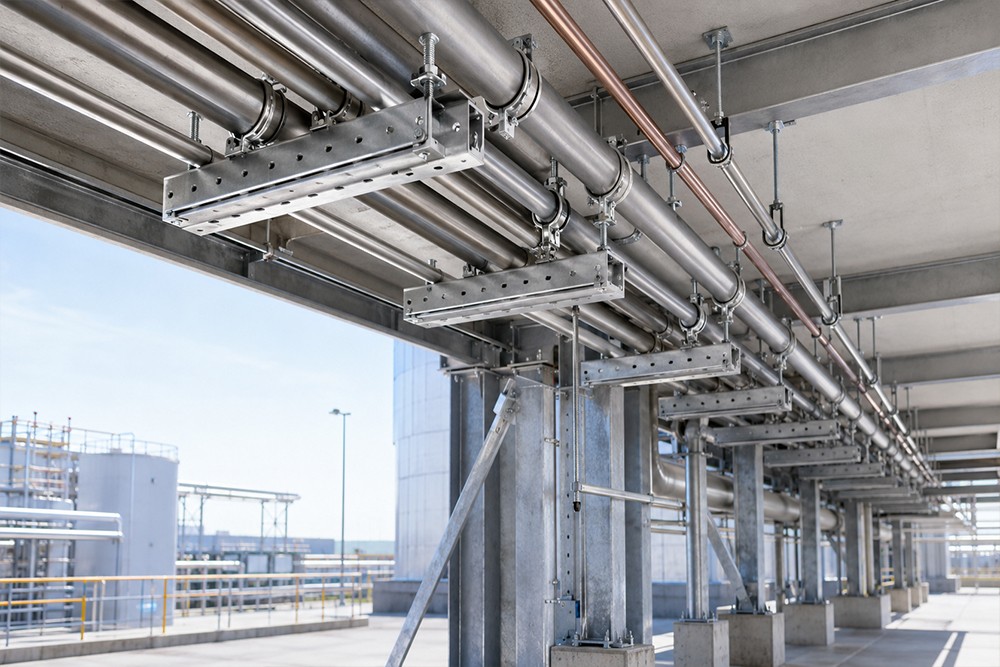
Pipe support systems are steel structures used to carry and secure process, compressed-air, fire-protection, water, drainage, steam and utility piping in factories and industrial facilities. They transfer pipe loads to the structure in a controlled manner, limit deflection and help maintain an organized piping route.
Each system is engineered specifically according to pipe diameter, material, operating weight, insulation thickness, temperature, vibration, support spacing, structural connections and corrosion conditions.
What Is a Pipe Support System?
A pipe support system is a structural assembly that connects horizontal or vertical piping to floors, walls, columns, ceilings or independent steel structures and transfers static and dynamic loads safely.
Depending on project requirements, the system may include:
- Steel columns and supporting frames
- Wall and column brackets
- Trapeze support systems
- Pipe clamps
- Fixed and sliding supports
- Guide supports
- Vibration isolators
- Base and connection plates
- Mechanical or chemical anchors
- Modular bolted connections
Advantages of Pipe Support Systems
Provide Safe Load Transfer
Carry the combined weight of pipes, fluids, insulation, valves and fittings at calculated support points.
Preserve Piping Geometry
Correct support spacing limits deflection and supports elevation, slope and route continuity.
Control Thermal Expansion
Fixed, sliding and guide supports manage movement caused by temperature changes.
Help Reduce Vibration and Noise
Rubber or spring isolation elements limit the transfer of dynamic effects from pumps, compressors and machinery.
Protect Connection Points
Reduce unnecessary loads on valves, flanges, expansion joints and equipment nozzles.
Offer a Modular and Expandable Structure
New lines, brackets or support modules can be added when the facility changes.
Types of Pipe Support Systems
Bracket-Type Pipe Supports
Carry single or multiple pipe runs on brackets connected to walls, columns or existing structures.
Trapeze Support Systems
Use horizontal cross-members and multiple clamps to carry several pipes at the same elevation.
Floor-Mounted Pipe Supports
Use independent columns and frames to transfer pipe loads directly to floors or concrete foundations.
Fixed and Sliding Supports
Fixed supports restrain movement at defined points, while sliding supports carry vertical loads and permit controlled thermal movement.
Vibration-Isolated Supports
Use rubber or spring elements on piping connected to dynamic equipment.
Heavy-Duty and Custom-Designed Supports
Reinforced for large diameters, high loads, long spans, confined areas or integration with existing structures.
Key Design Considerations
- Pipe diameter and material
- Operating weight, insulation and equipment loads
- Support spacing and spans
- Profile, column, cross-member and clamp sections
- Operating temperature and thermal expansion
- Fixed, sliding and guide-support locations
- Vibration from pumps and compressors
- Concrete, steel or existing structural connections
- Route and elevation
- Maintenance and intervention clearances
- Fire-safety and access-route requirements
- Environmental and corrosion conditions
Application Areas
- Manufacturing facilities
- Automotive and supplier industries
- Metalworking factories
- Food and beverage plants
- Chemical and pharmaceutical facilities
- Energy plants and boiler rooms
- Warehouses and logistics centers
- Water-treatment and pumping stations
- Fire-protection and sprinkler systems
- New facilities and capacity-expansion projects
Our Production and Installation Process
Each project is evaluated individually according to line load, temperature, route and site conditions.
1. Requirements Analysis and Site Survey
Pipe types, diameters, operating weights, insulation, temperature, existing structure, route and installation access are evaluated.
2. Route and Support Design
Pipe elevations, support spacing, fixed-sliding points, brackets, cross-members, frames, clamps and anchoring details are determined.
3. Manufacturing
Steel profiles, plates, brackets, cross-members, columns, base plates and custom parts are cut, drilled, machined and assembled according to technical drawings.
4. Surface Treatment and Quality Inspection
Blasting, primer, electrostatic powder coating, wet paint, galvanizing or stainless steel is selected. Dimensions, welds and installation compatibility are inspected.
5. Shipment and Site Installation
Support components are delivered; anchoring, alignment, clamping, fixed-sliding supports and vibration elements are installed.
6. Final Inspection and Handover
Support spacing, structural stability, pipe elevations, connections, thermal movement and maintenance access are checked before handover.
Modification and Reinforcement of Existing Pipe Supports
Existing support systems may require modification because of corrosion, loose connections, insufficient capacity, additional lines, route changes or vibration problems.
Following a technical inspection, the following works may be carried out:
- Bracket, cross-member and column renewal
- Clamp and connection-component replacement
- Adjustment of support spacing
- Addition of new frames or supports
- Installation of fixed and sliding supports
- Addition of vibration isolation
- Reinforcement of high-load points
- Base-plate and anchor modification
- Surface-coating renewal
Material and Surface Options
Material and surface treatment are selected according to line load, temperature, hygiene requirements and environmental conditions.
Carbon-Steel Profiles
Provide a durable and cost-effective solution for brackets, cross-members, columns and primary structures.
Galvanized Steel
Provides corrosion protection in indoor, semi-open and humid areas.
Stainless Steel
Provides hygiene and high corrosion resistance for food, chemical, pharmaceutical and wash-down areas.
Electrostatic Powder and Wet Paint
Provide durable surfaces for indoor applications or projects requiring corporate colors.
Clamps and Isolation Elements
Suitable inserts can protect pipe surfaces, reduce vibration and preserve insulation thickness.
Connections and Accessories
Anchors, bolts, fixed-sliding supports, vibration pads and custom connection plates are selected according to the project.
Why Nevas Çelik?
Projects are not limited to standard support dimensions; they are prepared according to actual line load, temperature, expansion, vibration, support spacing, structural connections and maintenance access.
Site survey, technical design, steel fabrication, surface treatment and site installation are managed within a single process. Reinforcement, route modification and capacity increase can also be carried out on existing pipe-support systems.
Information Required for a Quotation
- Pipe diameters and materials
- Approximate total line length
- Operating weight and fluid information
- Operating temperature and insulation thickness
- Site photographs
- Floor, wall, column, ceiling or existing structural information
- Support elevations and approximate spacing
- Fixed, sliding or vibration-isolated support requirements
- Indoor or outdoor use
- Preferred surface treatment
- Isometric drawings or technical specifications, if available
Frequently Asked Questions
Are pipe supports manufactured in standard dimensions?
No. Support type and dimensions are determined according to pipe diameter, operating weight, temperature, spacing and structural conditions.
Can supports be manufactured for large-diameter pipes?
Yes. Profiles, columns, cross-members, clamps, anchors and connection details are reinforced according to load information.
Can fixed and sliding supports be manufactured?
Yes. Fixed, sliding and guide supports can be designed according to thermal expansion and pipe movement.
Can special solutions be applied to vibrating lines?
Yes. Rubber pads, spring elements or suitable vibration isolation can be used on lines connected to pumps and compressors.
Can existing pipe supports be reinforced?
Yes. Brackets, columns, cross-members, clamps, anchors and support spacing can be renewed or reinforced following technical inspection.
Can pipe supports be used outdoors?
Yes. Hot-dip galvanizing, protective coating or stainless-steel options can be applied.
A Project-Specific Solution for Safe and Organized Piping Routes
Technical assessment and project engineering can be provided for a support system suited to pipe diameters, line loads, temperature and vibration conditions.
You can request a quotation for a new system, reinforcement of existing supports or additional piping by sharing your project information.