 Türkçe
Industrial Steel Crates | Custom-Sized Transport Crates
Industrial Steel Crates for Safe Storage and Handling
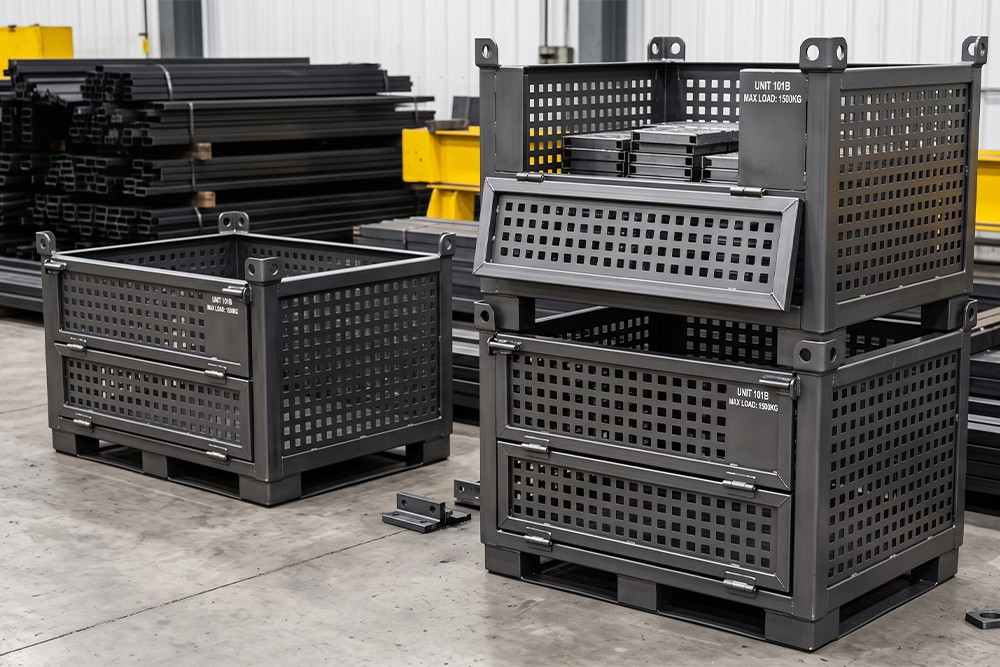
Steel crates are durable metal handling systems used to store, protect and transport parts, semi-finished products, equipment and heavy components throughout production, warehousing, dispatch and internal-logistics operations. They support organized stacking, controlled forklift or crane handling and more efficient use of storage space.
Each system is engineered specifically according to product dimensions, weight, stacking method, handling method, frequency of use and operating environment.
What Is an Industrial Steel Crate?
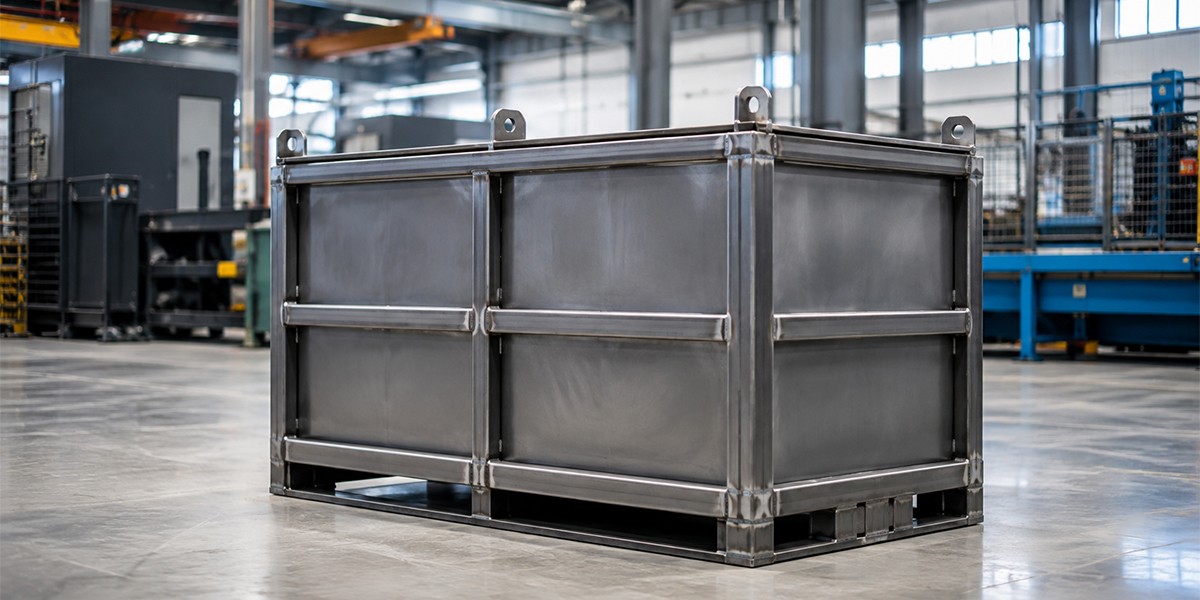
An industrial steel crate is a welded or modular metal structure used for the safe storage and handling of products, parts, tools, dies or equipment within a facility or between different locations.
Depending on project requirements, the system may include:
- Steel-profile supporting frame
- Sheet-metal, mesh or combined side panels
- Base plate and support profiles
- Forklift pockets
- Crane lifting lugs
- Stacking feet and corner elements
- Hinged or removable lids
- Dividers and product-fixing components
- Wheels and braking systems
- Labeling and identification areas
Advantages of Steel Crates
Protect Products Safely
Reduce the risk of impact, tipping and product movement during handling.
Facilitate Internal Handling
Support safe and controlled movement using forklift pockets, lifting lugs or wheeled systems.
Improve Storage-Space Efficiency
Stackable designs help use warehouse height and floor area more efficiently.
Support Organized Product Placement
Dividers, fixing elements and custom supports keep different parts arranged in a controlled manner.
Suitable for Repeated Use
Steel construction provides long service life in intensive production and logistics cycles.
Offer a Modular and Modifiable Structure
Crates can be extended, divided or rearranged when product dimensions or handling methods change.
Types of Steel Crates
Fixed Steel Crates
Rigid welded systems used for the regular storage and handling of specific products.
Stackable Steel Crates
Use stacking feet and corner details to provide safe vertical storage and save warehouse space.
Steel Crates with Lids
Provide more enclosed protection against external effects and uncontrolled access.
Mesh-Panel Steel Crates
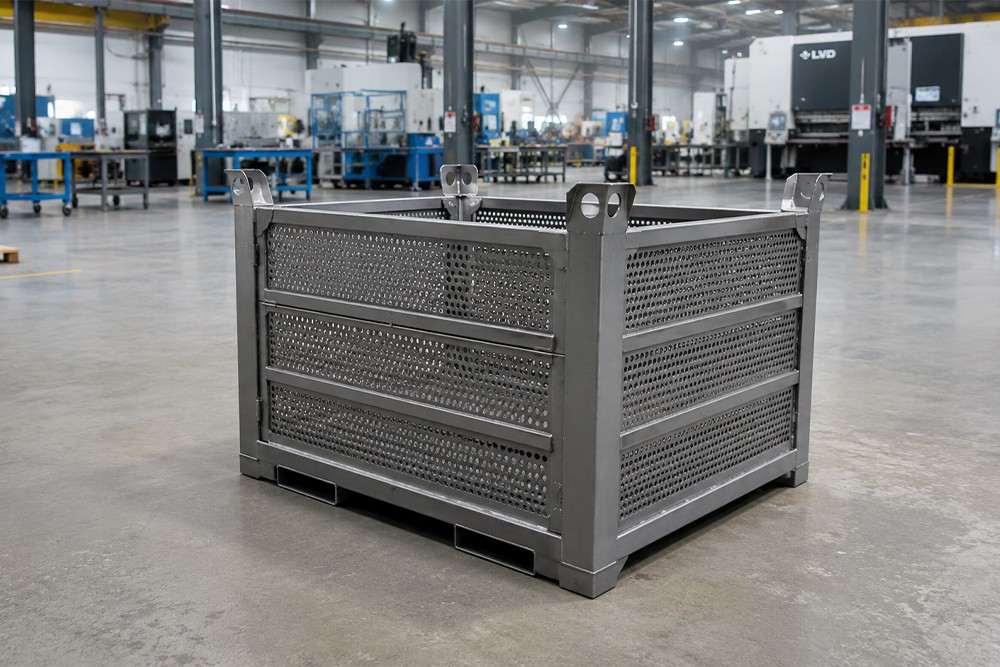
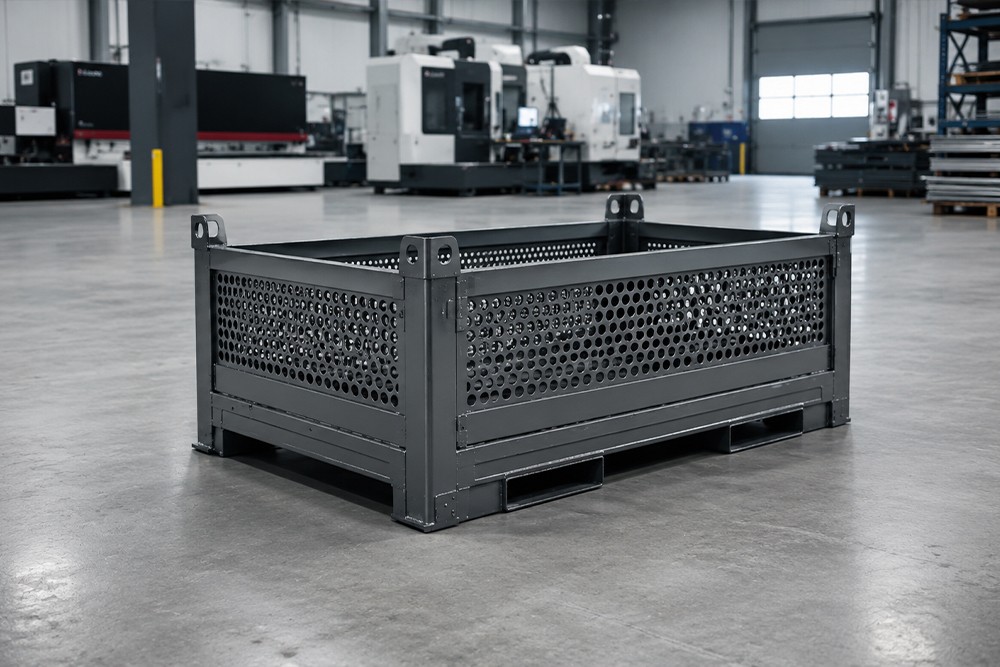
Maintain product visibility and airflow while creating a physical boundary.
Mobile Steel Crates
Can be moved easily within the facility using heavy-duty wheels and braking systems.
Custom Product-Handling Crates
Prepared with internal supports and fixing components for dies, fixtures, sensitive parts or products with special geometries.
Key Design Considerations
- Product dimensions and weight
- Center of gravity and load distribution
- Total crate capacity
- Forklift or crane handling method
- Stacking height
- Base and corner supports
- Product fixing and divider requirements
- Lid or opening-panel requirements
- Wheel and braking system
- Warehouse and vehicle dimensional limits
- Corrosion and operating environment
- Labeling and product tracking
Application Areas
- Automotive and supplier industries
- Metalworking facilities
- Machinery and equipment production
- Die and fixture handling
- White-goods and electronics manufacturing
- Defense and aerospace industries
- Warehouses and logistics centers
- Food and packaging facilities
- Spare-parts storage
- Internal production and dispatch lines
Our Production Process
Each project is evaluated individually according to product geometry, load capacity and handling scenario.
1. Technical Assessment and Requirements Analysis
Product dimensions, weight, frequency of use, stacking method and handling method are evaluated.
2. System Design
Crate dimensions, profile sections, base structure, forklift pockets, lifting points, lids and internal fixing elements are determined. Technical drawings are prepared.
3. Manufacturing
Steel profiles, sheet metal, mesh panels and connection components are cut, machined, bent and welded according to project dimensions.
4. Surface Treatment and Inspection
Electrostatic powder coating, wet paint, galvanizing or protective coating is applied. Dimensions, welds, stacking points and moving components are inspected.
5. Testing and Shipment Preparation
Where required, product placement, forklift entry, lifting points and stacking compatibility are checked.
6. Delivery and Site Application
The crates are delivered and final adjustments to wheels, lids, dividers or special fixing elements are completed before handover.
Steel Crate Modification and Reinforcement
Existing steel crates may develop impact deformation, weld cracks, corrosion, wheel failures, lid damage or wear at stacking elements over time.
Following a technical inspection, the following works may be carried out:
- Supporting-profile reinforcement
- Base and corner-element renewal
- Weld repair
- Forklift-pocket modification
- Addition of lifting lugs
- Lid and hinge renewal
- Wheel and braking-system replacement
- Addition of dividers and product-fixing components
- Surface-coating renewal
Material and Surface Options
Material and surface treatment are selected according to load capacity, frequency of use and operating environment.
Carbon-Steel Profiles
Form the main supporting frame of the crate. Profile sections are selected according to load and stacking conditions.
Sheet and Bent-Metal Components
Used for bases, side panels, lids, corners and special connection details.
Mesh and Perforated Panels
Preferred where product visibility, airflow or reduced weight is required.
Stainless Steel
Can be used where hygiene, wash-down resistance or high corrosion protection is required.
Electrostatic Powder Coating
Provides a durable surface suitable for indoor use and corporate colors.
Galvanizing and Industrial Coatings
Provide long-term protection in humid, outdoor or highly corrosive environments.
Why Nevas Çelik?
Projects are not limited to standard crate dimensions; they are prepared according to product geometry, load capacity, handling method and stacking conditions.
Site survey, design, steel fabrication, surface treatment and site application are managed within a single process. Reinforcement, dimensional modification and repurposing of existing crates can also be carried out.
Information Required for a Quotation
- Photographs of the product to be handled
- Product dimensions and total weight
- Number of products per crate
- Required crate dimensions
- Fixed, mobile or stackable use
- Forklift or crane handling method
- Open, mesh-panel or lidded design
- Divider and product-fixing requirements
- Indoor or outdoor use
- Preferred surface treatment and color
- Delivery and application location
Frequently Asked Questions
Are steel crates manufactured in standard dimensions?
No. They are engineered specifically according to product dimensions, weight, handling method and stacking conditions.
Can steel crates be handled by forklift?
Yes. Suitable forklift pockets and reinforced base structures can be integrated into the design.
Can steel crates be stacked?
Yes. Corner supports and stacking feet can be designed according to load conditions for safe vertical storage.
Can lidded or wheeled crates be manufactured?
Yes. Hinged, removable or lockable lids and heavy-duty wheels with brakes can be applied.
Can existing steel crates be modified?
Yes. Damaged areas, profiles, bases, lids, wheels, forklift pockets and internal dividers can be renewed or modified.
Can we order manufacturing only?
Yes. Depending on project scope, manufacturing-only, manufacturing and delivery, or delivery with site application options can be provided.
A Project-Specific Solution for Safe Storage and Handling
Technical assessment and project engineering can be provided for a steel-crate system suited to product dimensions, weight and logistics processes.
You can request a quotation for new production, modification of existing crates or improvement of the stacking system by sharing your project information.