 Türkçe
Industrial Steel Workbenches | Custom-Sized Steel Workbenches
Industrial Steel Workbenches for Safe and Organized Working Areas
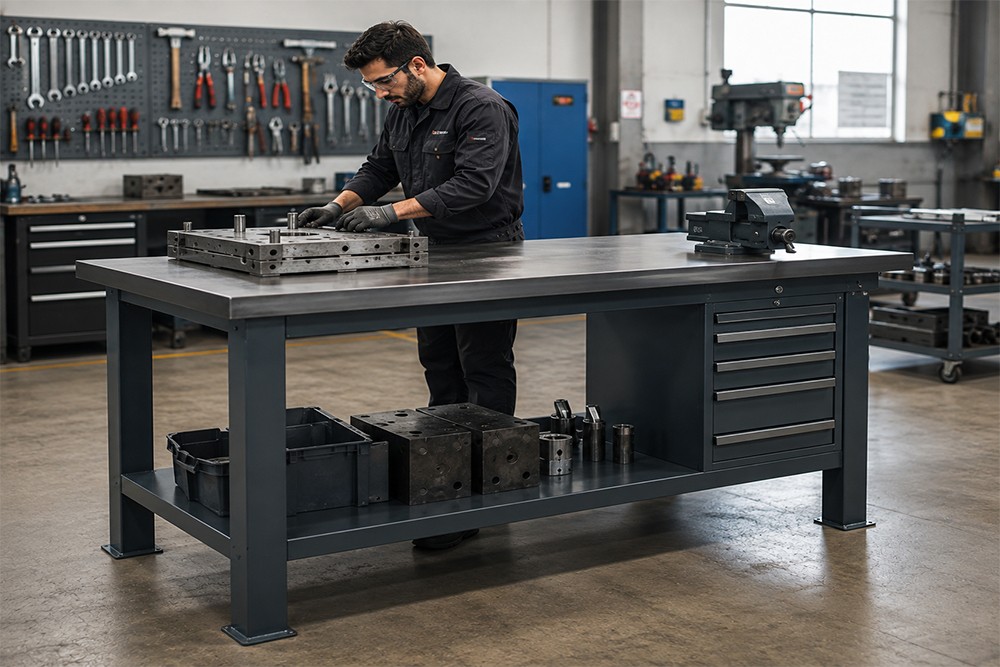
Steel workbenches are industrial systems that provide durable, organized and ergonomic working surfaces for production, assembly, maintenance and quality-control operations. They support safe positioning of parts, tools, fixtures and equipment while helping improve workspace efficiency.
Each workbench is engineered specifically according to the task, load capacity, operator ergonomics, equipment layout, work-surface requirements and facility conditions.
What Is an Industrial Steel Workbench?
An industrial steel workbench is a fixed, mobile or modular steel structure used to perform production, assembly, inspection and maintenance work safely and efficiently.
Depending on project requirements, the system may include:
- Steel-profile supporting frame
- Sheet-metal, stainless-steel or coated work surface
- Lower shelves and drawers
- Tool and equipment panels
- Vice and fixture connections
- Lighting and electrical channels
- Cable and socket modules
- Adjustable feet
- Heavy-duty wheels
- Modular connection components
Advantages of Steel Workbenches
Provide a Durable Working Surface
Create a rigid workspace that safely carries parts, tools and equipment.
Support Operator Ergonomics
Workbench height, reach distance and equipment layout can be arranged according to the task.
Organize the Working Area
Shelves, drawers, panels and hanging systems keep tools and consumables in controlled positions.
Support Precision Work
Provide a stable surface for fixtures, vices and measuring equipment.
Adapt to Facility Layout
Fixed, mobile, modular and custom-sized options can be adapted to different production areas.
Offer a Modifiable Structure
The workbench can be extended, reinforced or rearranged when workflows or equipment layouts change.
Types of Steel Workbenches
Fixed Steel Workbenches
Durable working systems used on adjustable feet or anchored to the floor.
Mobile Steel Workbenches
Can be moved within the facility using heavy-duty wheels and braking systems.
Modular Workbenches
Allow shelves, drawers, panels, lighting and accessories to be added according to need.
Heavy-Duty Workbenches
Manufactured with reinforced profiles and tabletops for heavy parts, dies and equipment.
Assembly and Quality-Control Workbenches
Adapted to production processes with fixtures, measuring equipment, lighting and ergonomic accessories.
Custom-Designed Workbenches
Developed specifically where standard solutions are insufficient for the required dimensions, load, equipment or process.
Key Design Considerations
- Workbench length, width and height
- Load capacity and load distribution
- Work-surface material
- Operator reach distance
- Shelf, drawer and panel requirements
- Vice and fixture connections
- Lighting and electrical requirements
- Fixed or mobile use
- Foot and wheel arrangement
- Floor and anchoring conditions
- Cleaning and maintenance access
- Corrosion and operating environment
Application Areas
- Production and assembly lines
- Quality-control areas
- Maintenance and repair workshops
- Toolrooms and die shops
- Automotive and supplier industries
- Metalworking facilities
- Food and packaging production
- Electrical and electronics assembly
- Warehouse and preparation areas
- Robotics and automation cells
Our Production Process
Each project is evaluated individually according to operating scenario, load capacity and site conditions.
1. Technical Assessment and Requirements Analysis
The task, workbench dimensions, load capacity, number of operators, equipment layout and site conditions are evaluated.
2. System Design
The supporting frame, work surface, shelves, drawers, panels, lighting and electrical accessories are determined. Technical drawings are prepared.
3. Manufacturing
Steel profiles, sheets, tabletops, shelves, drawers and connection components are cut, bent, machined and welded according to project dimensions.
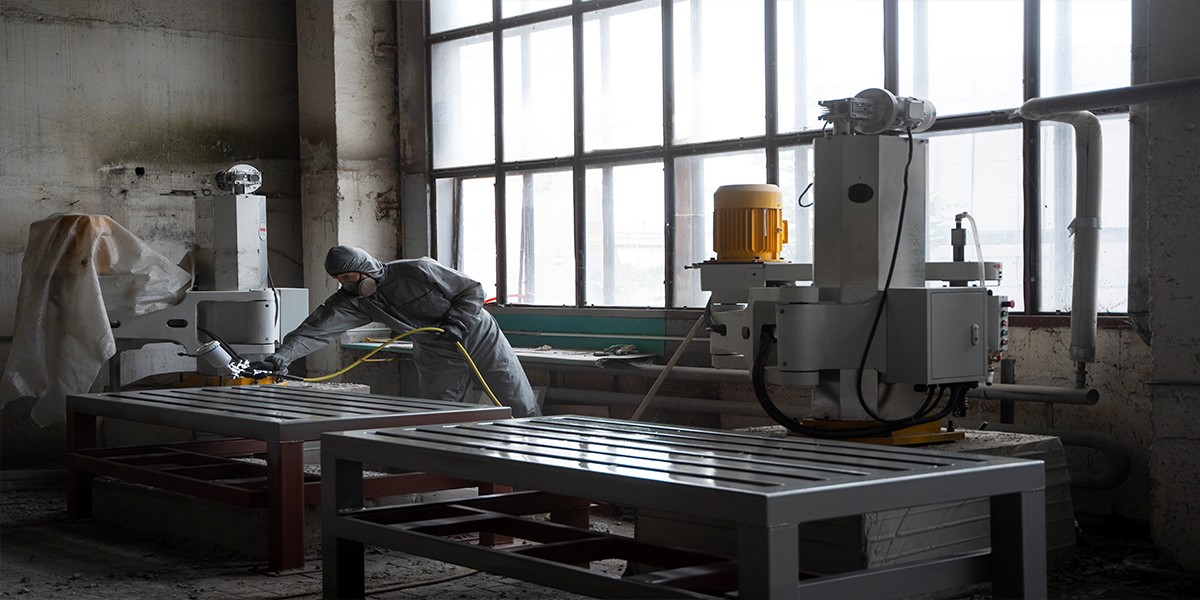
4. Surface Treatment and Inspection
Electrostatic powder coating, wet paint, galvanizing or protective coating is applied. Dimensions, welds, surface flatness and moving parts are inspected.
5. Accessory Installation and Testing
Drawers, shelves, panels, lighting, sockets, wheels and fixing components are installed and checked for usability.
6. Shipment and Site Handover
The workbench is delivered and final positioning, adjustment, anchoring and inspections are completed.
Steel Workbench Modification and Reinforcement
Existing workbenches may develop frame deformation, weld cracks, worn tabletops, drawer failures, wheel problems or corrosion over time. Increased load capacity or workflow changes may also require modification.
Following a technical inspection, the following works may be carried out:
- Supporting-frame reinforcement
- Work-surface renewal
- Addition of shelves and drawers
- Addition of tool panels
- Addition of vice and fixture connections
- Wheel and foot-system renewal
- Addition of lighting and electrical modules
- Dimensional and capacity modification
- Surface-coating renewal
Material and Surface Options
Material and surface treatment are selected according to load capacity, hygiene requirements and operating environment.
Carbon-Steel Profiles
Form the main supporting frame of the workbench. Sections are selected according to load capacity.
Steel-Sheet Work Surface
Provides an industrial surface resistant to impact, oil and intensive use.
Stainless Steel
Can be considered for applications requiring hygiene, wash-down resistance or high corrosion protection.
Wood and Composite Worktops
Can be used where product protection or a softer working surface is required.
Electrostatic Powder Coating
Provides a durable surface suitable for indoor use and corporate colors.
Galvanizing and Industrial Coatings
Provide long-term protection in humid, outdoor or corrosive environments.
Why Nevas Çelik?
Projects are not limited to standard workbench dimensions; they are prepared according to the task, load capacity, operator ergonomics and equipment layout.
Site survey, design, steel fabrication, accessory integration, surface treatment and site handover are managed within a single process. Reinforcement, accessory addition and dimensional modification of existing workbenches can also be carried out.
Information Required for a Quotation
- Required workbench dimensions
- Type of work to be performed
- Load capacity
- Number of operators
- Preferred work-surface material
- Shelf, drawer and panel requirements
- Vice or fixture connections
- Lighting and electrical expectations
- Fixed or mobile use
- Preferred color and surface treatment
- Delivery and operating location
Frequently Asked Questions
Are steel workbenches manufactured in standard dimensions?
No. Workbench dimensions, load capacity, accessories and working height are determined according to operational requirements.
Can heavy-duty workbenches be manufactured?
Yes. Reinforced profiles, thicker worktops and suitable foot systems can be used for heavy parts.
Can drawers, shelves and tool panels be added?
Yes. Workbenches can be completed with drawers, shelves, panels, hanging accessories and custom storage areas.
Can mobile workbenches be manufactured?
Yes. Heavy-duty swivel and braked wheels can be integrated into the design.
Can stainless-steel workbenches be manufactured?
Yes. Stainless-steel options can be used according to hygiene, wash-down and corrosion requirements.
Can an existing workbench be modified?
Yes. Worktops, frames, drawers, shelves, wheels, electrical modules and surface coatings can be renewed.
A Project-Specific Solution for Safe and Organized Working Areas
Technical assessment and project engineering can be provided for a steel workbench suited to production, assembly, maintenance or quality-control operations.
You can request a quotation for new production, reinforcement of an existing system or accessory integration by sharing your project information.