 Türkçe
Turnstile Areas | Industrial Access Control
Industrial Turnstile Areas for Safe and Controlled Personnel Access
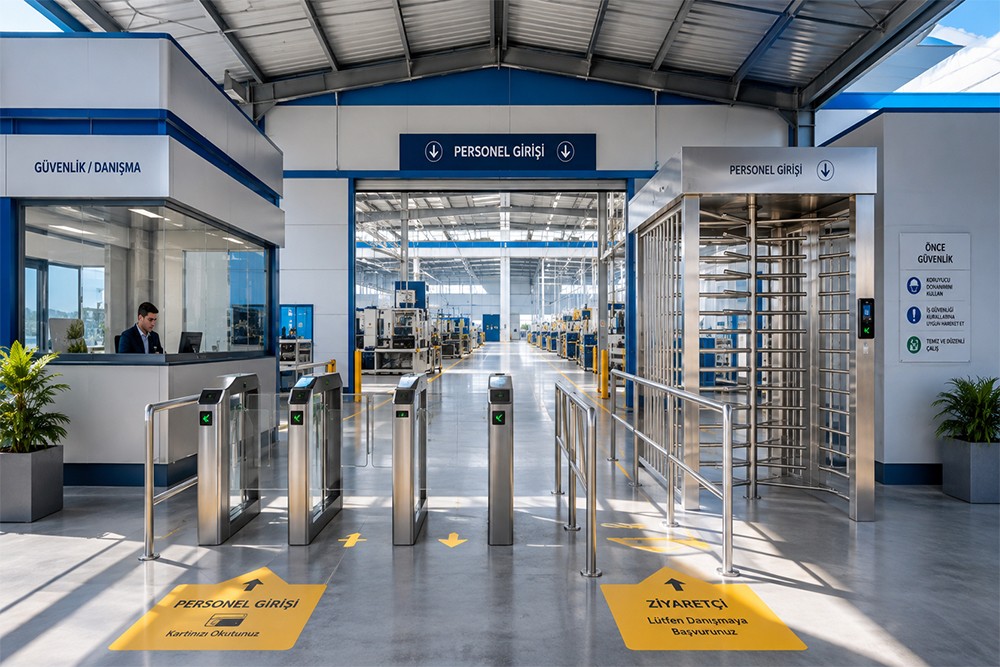
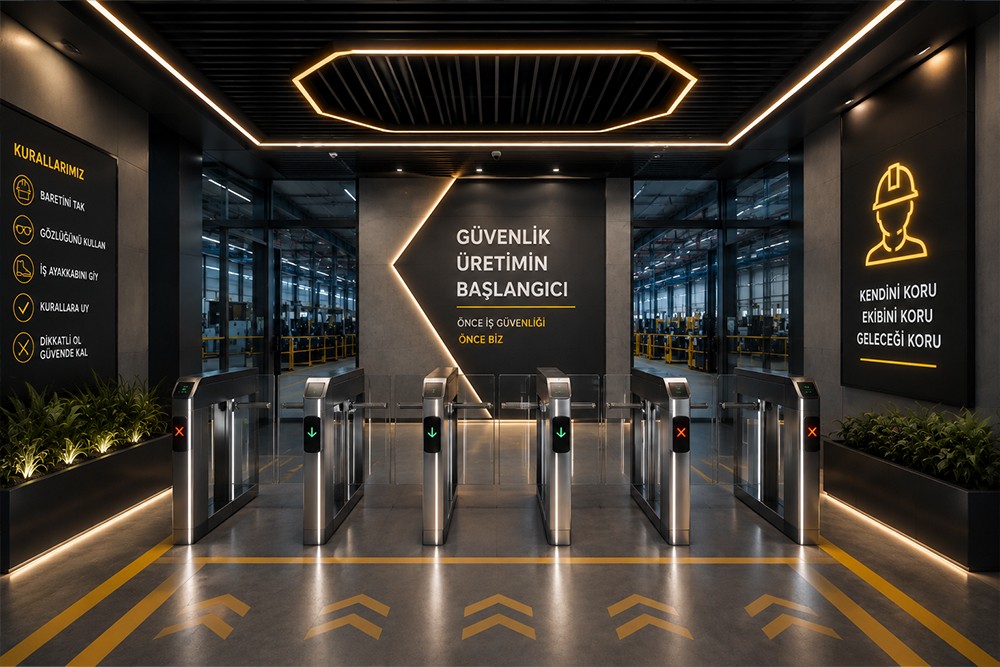
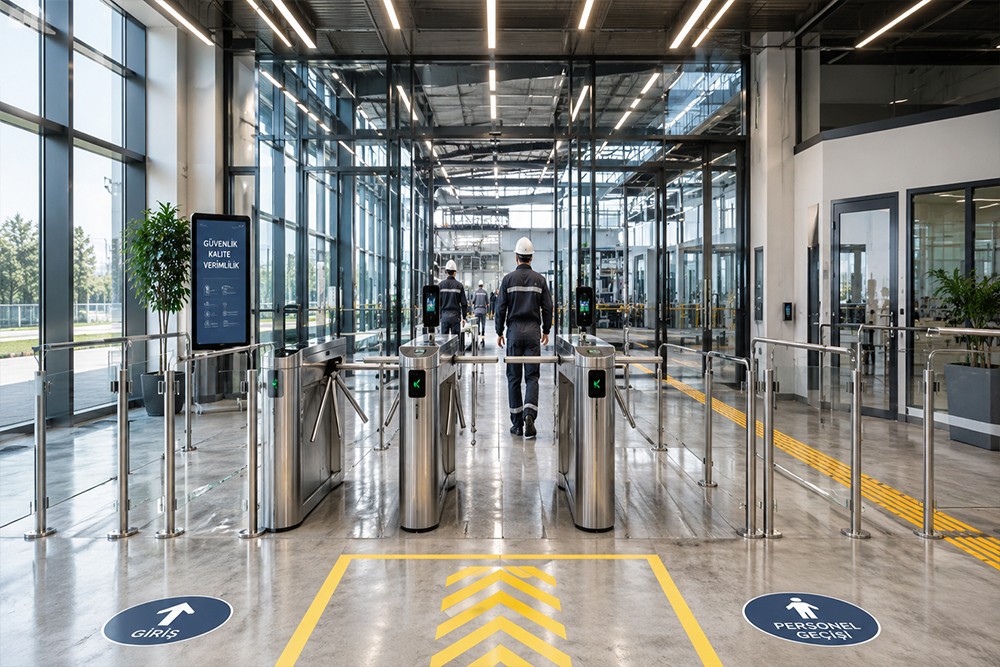
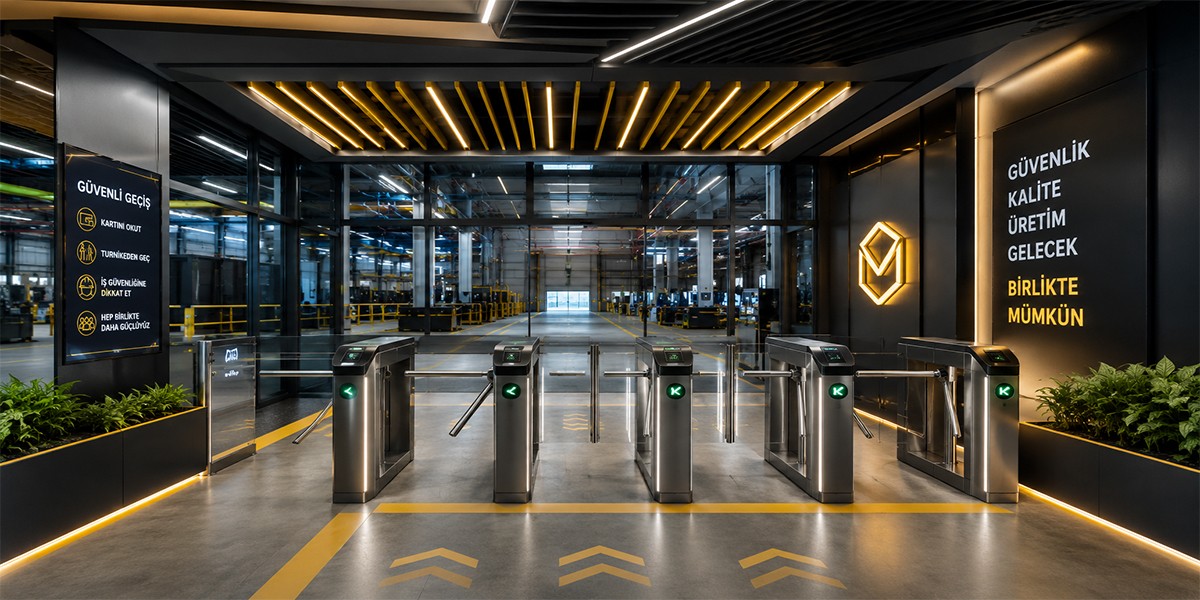
Turnstile areas are access-control solutions that concentrate employee, visitor and contractor movement at defined points in factories, warehouses and industrial facilities. They combine physical guidance with electronic authorization to restrict uncontrolled passage, organize personnel flow and create safer facility entrances.
Each system is engineered specifically according to personnel density, shift changes, turnstile type, number of lanes, emergency-exit requirements, accessible passage, electrical-data infrastructure, vehicle traffic and site geometry.
What Is a Turnstile Area?
A turnstile area is a controlled entry-exit zone where turnstiles are integrated with steel barriers, guidance corridors, gates, equipment supports and anchoring components.
Depending on project requirements, the system may include:
- Waist-high or full-height turnstiles
- Steel barriers and guidance panels
- Personnel and visitor corridors
- Emergency-exit gates
- Card-reader and biometric-device supports
- Cable channels and protective enclosures
- Security-booth connections
- Impact-protection barriers
- Canopies and overhead covers
- Base plates and anchors
Advantages of Turnstile Areas
Restrict Unauthorized Passage
Steel barriers and controlled gates direct users to the designated access point and limit bypassing around turnstiles.
Organize Personnel Flow
Single or multiple lanes create more controlled movement during shift changes.
Integrate with Electronic Systems
Provide suitable mechanical and cabling infrastructure for card readers, fingerprint readers, facial-recognition devices and personnel-tracking systems.
Support Emergency Evacuation
Panic-bar or controlled emergency-exit gates can be integrated to maintain evacuation safety.
Can Be Protected from Vehicle Traffic
Independent impact barriers can create a safer passage zone near forklifts and service vehicles.
Offer a Modular and Expandable Structure
The number of turnstiles, corridor layout and barrier system can be modified when personnel numbers or facility layouts change.
Types of Turnstile Areas
Waist-High Turnstile Areas
Provide compact controlled-access solutions for factories and administrative-building entrances.
Full-Height Turnstile Security Areas
Provide complete passage control in warehouses, perimeter zones and high-security production areas.
Multi-Lane Turnstile Areas
Increase entry and exit capacity in facilities with high personnel density.
Turnstile and Emergency-Gate Combinations
Maintain normal access control while allowing fast and unobstructed evacuation.
Card and Biometric Access Areas
Prepared with equipment supports, enclosures and cabling infrastructure for electronic authorization devices.
Covered Outdoor Turnstile Areas
Protect users and electronic equipment from rain, sunlight and outdoor conditions.
Key Design Considerations
- Daily personnel numbers and shift density
- Turnstile type, quantity and throughput
- Entry and exit directions
- Corridor width and waiting areas
- Card-reader or biometric-device position
- Electrical and data infrastructure
- Emergency exit and accessible passage
- Relationship with the security booth
- Forklift and service-vehicle traffic
- Floor, concrete and anchoring conditions
- Outdoor conditions and canopy requirements
- Visibility and wayfinding elements
Application Areas
- Factory and production-facility entrances
- Warehouses and logistics centers
- Automotive and supplier industries
- Metalworking and machinery manufacturing
- Food and pharmaceutical facilities
- Energy and technical facilities
- Construction and project sites
- Organized industrial zones
- Controlled production areas
- Personnel and visitor entry points
Our Production and Installation Process
Each project is evaluated individually according to personnel flow, security level and site conditions.
1. Requirements Analysis and Site Survey
Personnel numbers, shift patterns, entrance area, floor conditions, vehicle routes, electrical infrastructure and emergency exits are evaluated.
2. Capacity and Layout Design
Turnstile quantity, corridors, waiting areas, entry-exit directions, visitor passages and emergency-exit gates are determined.
3. Manufacturing
Steel barriers, gates, supports, enclosures and custom connection components are manufactured according to technical drawings.
4. Surface Treatment and Quality Inspection
Electrostatic powder coating, industrial wet paint or galvanizing is applied. Dimensions, connections, gate movement and turnstile compatibility are inspected.
5. Shipment and Site Installation
Steel systems are anchored, and turnstiles, barriers, gates, cable channels and protection components are installed according to the layout.
6. Final Inspection and Handover
Passage directions, gates, barrier continuity, turnstile compatibility, cable infrastructure and site safety are checked before handover.
Modification and Expansion of Existing Turnstile Areas
Existing turnstile areas may require modification when personnel numbers increase, entrances move or new access-control systems are introduced. Barrier damage, gate failures, insufficient lane capacity and outdoor exposure may also require updates.
Following a technical inspection, the following works may be carried out:
- Addition of new turnstile lanes
- Barrier and guidance-panel replacement
- Addition of emergency-exit gates
- Integration of card-reader and biometric-device supports
- Cable-channel and enclosure renewal
- Addition of canopies or overhead covers
- Installation of impact-protection barriers
- Route and waiting-area modification
- Renewal of anchors and surface coatings
Material and Surface Options
Materials and surface treatments are selected according to security level, usage intensity, outdoor exposure and visual requirements.
Carbon-Steel Profiles
Provide durable and cost-effective solutions for barriers, gates, supports and enclosures.
Sheet and Bent-Metal Components
Used for guidance panels, gate surfaces, device supports and protective enclosures.
Stainless Steel
Can be considered for special applications requiring hygiene, intensive use or high corrosion resistance.
Electrostatic Powder and Wet Paint
Available in different RAL colors and suitable for matching the facility's corporate appearance.
Galvanized Coating
Provides long-term protection in outdoor, humid or corrosive environments.
Electronic-System Accessories
Supports and cabling infrastructure can be prepared for card readers, biometric devices, sensors, control panels and personnel-tracking systems.
Why Nevas Çelik?
Projects are not limited to standard turnstile layouts; they are prepared according to actual personnel density, entrance geometry, security level, electronic systems, emergency-exit layout and vehicle traffic.
Site survey, layout planning, steel fabrication, surface treatment and professional installation are managed within a single process. Expansion, barrier modification, gate addition and electronic-infrastructure adaptation can also be carried out on existing turnstile areas.
Information Required for a Quotation
- Dimensions and photographs of the application area
- Daily personnel numbers and shift density
- Turnstile type and quantity
- Entry and exit directions
- Card-reader or biometric-system information
- Emergency-exit gate requirements
- Floor and concrete information
- Electrical and data infrastructure
- Forklift or vehicle-traffic risk
- Outdoor canopy requirements
- Preferred paint or galvanizing option
- Installation location and work schedule
Frequently Asked Questions
Why should a turnstile area be enclosed with steel barriers?
Barriers guide users to the designated passage and limit uncontrolled bypassing around turnstiles.
Can it be installed in an existing factory?
Yes. Staged installation can be planned according to the existing entrance arrangement and operating hours.
Which turnstile types are supported?
Infrastructure can be prepared for waist-high, full-height, speed-gate and project-specific turnstile systems.
Can an emergency-exit gate be added?
Yes. Panic-bar or controlled emergency-exit gates can be integrated into the turnstile area.
Can infrastructure be provided for card readers and biometric devices?
Yes. Supports, enclosures and protected cable routes can be included in the project scope.
Can it be used outdoors?
Yes. Galvanizing, suitable coating and canopy solutions can be used for outdoor conditions.
A Project-Specific Solution for Safe and Organized Personnel Entry
Technical assessment and project engineering can be provided for a turnstile area suited to your personnel density, turnstile type, security level and entrance layout.
You can request a quotation for a new turnstile area, expansion of an existing system or barrier, gate and electronic-infrastructure modifications by sharing your project information.