 Türkçe
Conveyor Extension | Production Line Modification
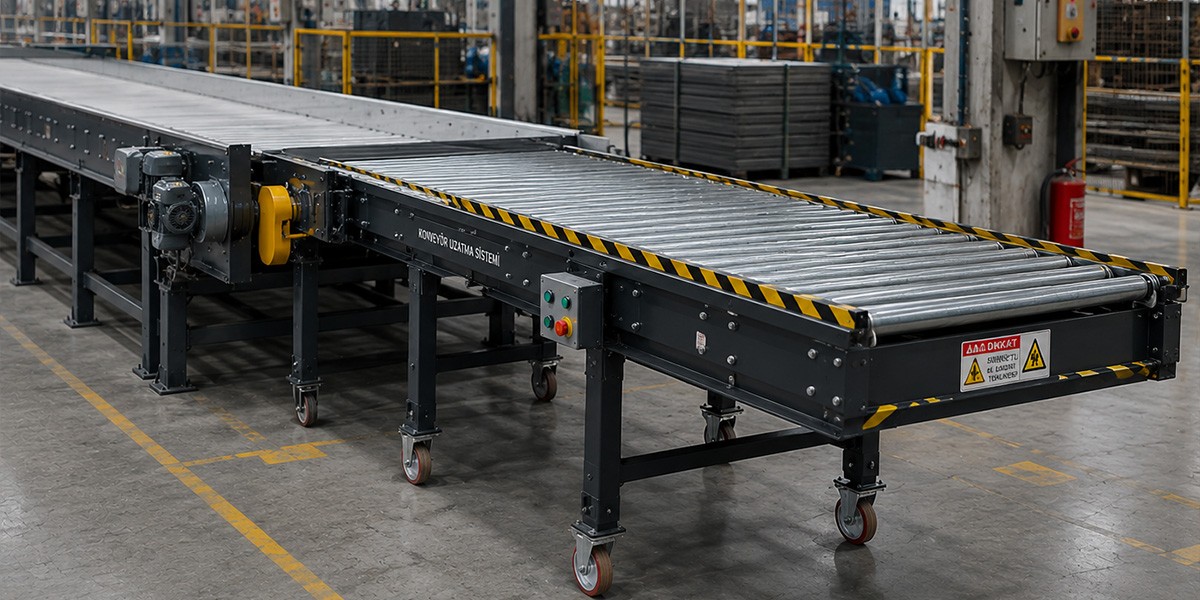
Conveyor Extension Solutions for Industrial Production Lines
Conveyor extension is the addition of new modules to existing conveyor systems to increase production capacity, add workstations, improve product flow or develop the facility layout. Properly engineered extensions for roller, chain and belt conveyors increase transport distance, processing capacity and usable space while preserving the operating logic of the existing line.
Each project is engineered specifically according to conveyor type, product dimensions and weight, load capacity, operating speed, line elevation, drive system, transfer points, sensors, safety equipment and facility layout.
What Is Conveyor Extension?
Conveyor extension is the integration of new mechanical and, where required, electrical and automation modules into an existing production or handling system to increase its physical length and process capacity.
Depending on project requirements, the system may include:
- Steel supporting frames and legs
- Roller, chain or belt modules
- Transfer tables and turning stations
- Operator and quality-control stations
- Product guides and directional components
- Motors, gearboxes and transmission components
- Sensors and control equipment
- Protective guards and barriers
- Base plates and anchors
- Bolted and removable connections
Advantages of Conveyor Extension
Increase Handling and Production Capacity
New transport sections, stations and transfer areas help the line accommodate more products and operations.
Utilize the Existing System
The operating conveyor is developed instead of replacing the complete line, supporting a more controlled investment.
Improve Product Flow
Accumulation areas, station spacing and transfer points are redesigned for smoother product movement.
Support New Machines and Stations
Connection areas can be created for test units, packaging equipment, quality control or operator stations.
Improve Maintenance Access
Service clearances for motors, gearboxes, bearings, sensors and moving equipment are included in the design.
Offer a Modular and Upgradeable Structure
Removable, expandable and reusable modules can be applied for future capacity increases.
Types of Conveyor Extension
Roller Conveyor Extensions
New modules are added to roller conveyors carrying boxes, crates, pallets and similar products.
Chain Conveyor Extensions
Additional sections compatible with the existing chain and drive system are prepared for heavy loads, pallets or special carriers.
Belt Conveyor Extensions
Transport distance is increased after evaluating belt width, tensioning arrangement and motor capacity.
Assembly and Operator-Line Extensions
New workstations, equipment layouts and ergonomic work areas are added to improve line capacity.
Transfer and Turning Modules
Custom solutions are used to change product direction, accumulate products or transfer them to another line.
Custom-Geometry Conveyor Extensions
Prepared in custom dimensions and angles for restricted areas, column zones, different elevations or machinery layouts.
Key Design Considerations
- Technical structure of the existing conveyor
- Product dimensions, weight and surface properties
- Load capacity and operating speed
- Line axis, elevation and alignment
- Motor, gearbox and transmission capacity
- Roller, chain or belt specifications
- Transfer points and transition clearances
- New machine and station connections
- Supporting-frame and leg layout
- Floor and anchoring conditions
- Sensors and safety equipment
- Environmental and corrosion conditions
Application Areas
- Automotive and supplier industries
- Metalworking and machinery manufacturing
- Plastic and rubber production
- Food and packaging facilities
- White-goods and electronics production
- Warehouses and logistics centers
- Assembly and quality-control lines
- Packaging and shipping lines
- Product-transfer systems
- Organized industrial facilities
Our Application Process
Each project is evaluated individually according to the existing system, capacity target and site conditions.
1. Requirements Analysis and Site Survey
Conveyor type, current and target length, product specifications, operating speed, machine connections, floor and installation area are evaluated.
2. Layout and System Design
New modules, stations, transfer points, supporting legs, operator areas and safety components are planned according to production flow.
3. Technical Engineering and Manufacturing
Supporting frames, roller, chain or belt modules, connection plates, drive and sensor layouts are prepared according to technical drawings.
4. Surface Treatment and Quality Inspection
Electrostatic powder coating, wet paint, galvanizing or suitable protective coating is applied. Dimensions, welds, axes and moving components are inspected.
5. Site Installation and Integration
New modules are aligned and anchored; mechanical connections, sensors and project-scope electrical and automation connections are completed.
6. Testing, Commissioning and Handover
The conveyor is tested without load and with products; speed, alignment, transfer points, sensors and safety equipment are checked before handover.
Modification and Development of Existing Conveyors
During extension, the capacity of the existing supporting frame, drive, transfer, sensor and safety components should be evaluated together. Components that are insufficient for the new capacity can be renewed or reinforced.
Following a technical inspection, the following works may be carried out:
- Reinforcement of supporting frames and legs
- Modification of motor and gearbox capacity
- Renewal of rollers, chains, belts or guides
- Improvement of transfer points
- Addition of sensors and control components
- Adaptation of guards and safety barriers
- Renewal of base plates and anchors
- Correction of line elevation and alignment
- Addition of stations and operator areas
Material, Surface and System Options
Materials and systems are selected according to the handled product, load capacity, operating speed, environmental conditions and existing conveyor structure.
Steel Supporting Sections
Box sections, U-sections or custom profiles can be used for main frames, legs, cross members and connections according to load and span.
Roller, Chain and Belt Systems
Selected with suitable diameter, width, capacity and surface characteristics according to product and process requirements.
Transfer Tables and Guides
Custom-designed for product direction, accumulation or transfer to another line.
Protective Guards and Barriers
Steel sheet, wire mesh or suitable safety components can be applied around moving mechanisms and restricted areas.
Base Plates and Anchors
Mechanical or chemical anchors safely transfer supporting-leg loads to the floor.
Galvanizing and Paint Systems
Electrostatic coating, industrial wet paint, galvanizing or special coatings can be applied according to indoor and outdoor conditions.
Why Nevas Çelik?
Projects are not treated as simply attaching additional parts to an existing conveyor; load capacity, speed, drive structure, product transfer, safety equipment and relationships with surrounding machinery are evaluated together.
Site survey, technical design, steel fabrication, mechanical integration, surface treatment, site installation and commissioning are managed within a single process. Work in active facilities can be phased during off-shift hours, weekends or planned shutdowns.
Information Required for a Quotation
- Type and purpose of the conveyor to be extended
- Existing and target line length
- Product dimensions and weight
- Target capacity and operating speed
- Photographs and videos of the application area
- Existing layout or technical drawings
- Motor, gearbox and drive-system information
- New station or machine requirements
- Floor and supporting-structure information
- Sensor, electrical and automation integration
- Indoor or outdoor conditions
- Installation schedule and production-shutdown restrictions
Frequently Asked Questions
Are conveyor-extension systems manufactured in standard dimensions?
No. Length, width, load capacity, drive and connection details are determined specifically according to the existing system.
Can an existing conveyor be extended later?
Yes. New modules can be integrated after evaluating the technical condition of the current conveyor and facility layout.
Can the existing motor and drive system be retained?
Motor power, gearbox ratio, speed and load capacity are evaluated; the existing system may be retained or reinforced where suitable.
Can roller, chain or belt systems be applied?
Yes. Roller, chain, belt or custom transfer solutions can be used according to the product and process.
Can sensors and safety equipment be included?
Yes. Sensors, emergency stops, protective guards and control equipment can be integrated within the project scope.
Can conveyor modules be dismantled and reused elsewhere?
Bolted and modular sections can be dismantled and reinstalled where the new layout dimensions are suitable.
A Project-Specific Conveyor Extension for Your Production Flow
A conveyor-extension project can be prepared according to your existing system, product specifications, capacity target and facility layout.
You can request a quotation for roller, chain or belt module additions, transfer-point modifications, new-station integration or complete conveyor development by sharing your project information.