 Türkçe
Pipe Bridges | Industrial Pipe Support Systems
Safe and Durable Pipe Bridges for Industrial Facilities
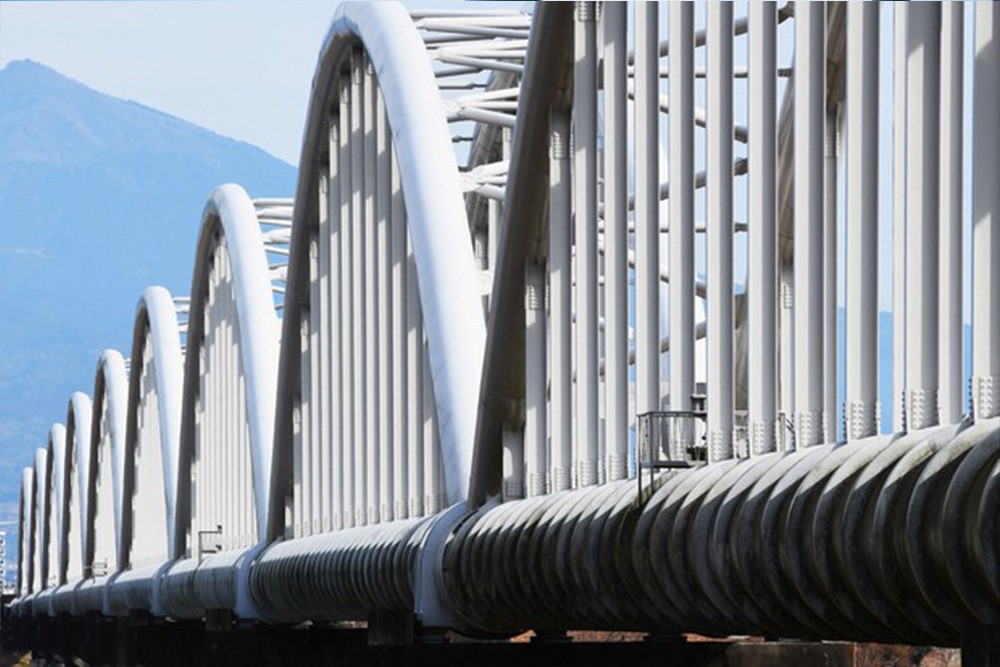
Pipe bridges are steel structures used to carry process, energy, water, steam, compressed-air, gas and chemical lines safely at a defined elevation between different parts of an industrial facility. They organize utility routes, improve ground-level use and simplify access to maintenance points.
Each system is engineered specifically according to pipe diameters, number of lines, fluid properties, operating temperatures, total loads, spans, column layout, thermal movement, maintenance requirements and site conditions.
What Is a Pipe Bridge?
A pipe bridge is a steel supporting system consisting of columns, beams, bracing, pipe supports and connection components that carries industrial piping, cable trays and auxiliary utilities at a defined elevation.
Depending on project requirements, the system may include:
- Steel columns, beams and bracing
- Pipe-supporting cross members
- Fixed and sliding pipe supports
- Clamps, shoes and hanger systems
- Cable-tray supports
- Maintenance platforms
- Stairs and guardrails
- Base plates and anchors
- Bolted modular connections
- Thermal-expansion and movement details
Advantages of Pipe Bridges
Carry Utility Lines Safely and Systematically
Transfer pipe, valve, insulation, cable-tray and auxiliary-equipment loads to the supporting structure in a controlled manner.
Organize Facility Layout
Collect different utility lines along a defined route and support more efficient use of production and service areas.
Simplify Maintenance Access
Platforms, stairs and guardrails can be added where access to valves, flanges, instruments and inspection points is required.
Limit Deflection and Vibration
Suitable structural sections, bracing and support layouts help maintain stable operation.
Accommodate Thermal Expansion
Fixed and sliding support points can be included to manage movement in hot piping systems.
Offer Expandable Capacity
Reserve space can be provided for future pipe, cable or auxiliary utility lines.
Types of Pipe Bridges
Single-Span Pipe Bridges
Compact supporting systems used for short-distance crossings.
Multi-Span Pipe Bridges
Systems extending along longer routes with intermediate columns and capacity for multiple lines.
Combined Pipe and Cable Bridges
Carry piping, cable trays and auxiliary utilities on the same structure.
Pipe Bridges with Maintenance Platforms
Provide safe walking and working areas at inspection and service points.
Modular Pipe Bridges
Use bolted connections to simplify shipment, installation, expansion and modification.
Heavy-Duty and Custom-Geometry Systems
Prepared for large-diameter, dense or high-temperature lines and routes requiring bends, steps or adaptation around site obstacles.
Key Design Considerations
- Pipe diameters, quantities and total load
- Fluid type and operating temperature
- Pipe, insulation and valve weights
- Spans and column layout
- Static and dynamic effects
- Wind and seismic conditions
- Deflection and vibration limits
- Thermal expansion and movement
- Fixed and sliding support points
- Maintenance-platform requirements
- Floor, foundation and anchoring conditions
- Future capacity increases
Application Areas
- Factories and production facilities
- Energy plants and boiler rooms
- Chemical and petrochemical facilities
- Food and beverage plants
- Automotive and supplier industries
- Water and treatment plants
- Logistics and storage areas
- Mining and heavy industry
- Compressor and technical utility areas
- Outdoor process-line routes
Our Production and Installation Process
Each project is evaluated individually according to line loads, route and site conditions.
1. Requirements and Technical Data Analysis
Pipe lists, diameters, fluid information, operating temperatures, line loads, route and maintenance requirements are evaluated.
2. Site Survey and Layout Design
Spans, elevations, column locations, floor conditions, existing structures and connection routes are examined on site.
3. Technical Engineering and Manufacturing
Columns, beams, bracing, platforms, pipe supports and anchoring details are engineered and manufactured according to technical drawings.
4. Surface Treatment and Quality Inspection
Galvanizing, primer, electrostatic powder coating or industrial wet paint is applied. Dimensions, welds, geometry and connection points are inspected.
5. Trial Assembly and Shipment
Bolted modules, supports, platforms and connection details are checked before shipment.
6. Site Installation and Handover
Columns, beams, bracing, platforms and pipe supports are installed; elevations, alignment and connections are checked before handover.
Modification and Reinforcement of Existing Pipe Bridges
Corrosion, deflection, loose connections, weld damage, vibration or the addition of new lines may require existing pipe bridges to be modified. Before increasing capacity, the supporting structure, anchors and pipe supports should be evaluated together.
Following a technical inspection, the following works may be carried out:
- Reinforcement of columns and beams
- Addition of new bracing and supports
- Renewal of pipe-supporting cross members
- Modification of fixed and sliding supports
- Reinforcement of connections and anchors
- Addition of maintenance platforms
- Extension or widening of the structure
- Creation of reserve capacity for new lines
- Surface-coating renewal
Material and Surface Options
Materials and surface systems are selected according to load capacity, outdoor exposure, corrosion conditions and facility standards.
Carbon-Steel Profiles
Provide high strength and cost-effective production for general industrial applications.
Galvanized Steel
Provides long-term protection in outdoor and highly corrosive environments.
Plate and Bent-Sheet Components
Used for base plates, gussets, connections and custom pipe supports.
Bolted Connection Systems
Simplify shipment, site installation and future modifications.
Electrostatic Powder and Industrial Wet Paint
Provide durable protection compatible with facility color standards after suitable surface preparation.
Hot-Dip Galvanizing
Provides strong corrosion protection in humid and outdoor environments.
Why Nevas Çelik?
Projects are not limited to standard supporting dimensions; they are prepared according to actual line loads, spans, temperature effects, thermal movement, maintenance requirements and site conditions.
Site survey, technical design, steel fabrication, surface treatment and professional installation are managed within a single process. Reinforcement, extension, platform addition, connection and surface modifications can also be carried out on existing pipe bridges.
Information Required for a Quotation
- Pipe diameters, quantities and line list
- Fluid types and operating temperatures
- Pipe, insulation and equipment loads
- Total route and span dimensions
- Site information suitable for column layout
- Technical drawings or 3D models, if available
- Pipe-support type and spacing
- Cable-tray or maintenance-platform requirements
- Floor, foundation and anchoring information
- Wind, seismic and site-load conditions
- Preferred galvanizing or paint system
- Photographs and dimensions for existing-system modification
Frequently Asked Questions
Which materials are pipe bridges made from?
They are generally manufactured from steel box sections, U-sections, I-sections and steel plates. Structural sections are selected according to line loads and spans.
Are pipe bridges manufactured in standard dimensions?
No. They are designed specifically according to route, spans, pipe loads, temperature effects and site conditions.
Can cable trays be carried on the same structure?
Yes. Piping and cable systems can be carried on the same structure using suitable cross members and separated routes.
Can a maintenance platform be added?
Yes. Platforms, guardrails and stairs can be included for access to valves and inspection points.
Can an existing pipe bridge be reinforced?
Yes. Structural sections, bracing, anchors, connections and pipe supports can be reinforced following technical inspection.
Can the system be hot-dip galvanized?
Yes. Hot-dip galvanizing can be applied according to outdoor and corrosion conditions.
A Project-Specific Solution for Safe and Long-Lasting Pipe Support
Technical assessment and project engineering can be provided for a pipe bridge suited to your utility lines, route, spans and site conditions.
You can request a quotation for a new system, reinforcement of an existing bridge or capacity, platform, support and surface modifications by sharing your project information.