 Türkçe
Steel Support Structures | Industrial Load-Bearing Structures
Industrial Steel Supports for Safe and Durable Load Transfer
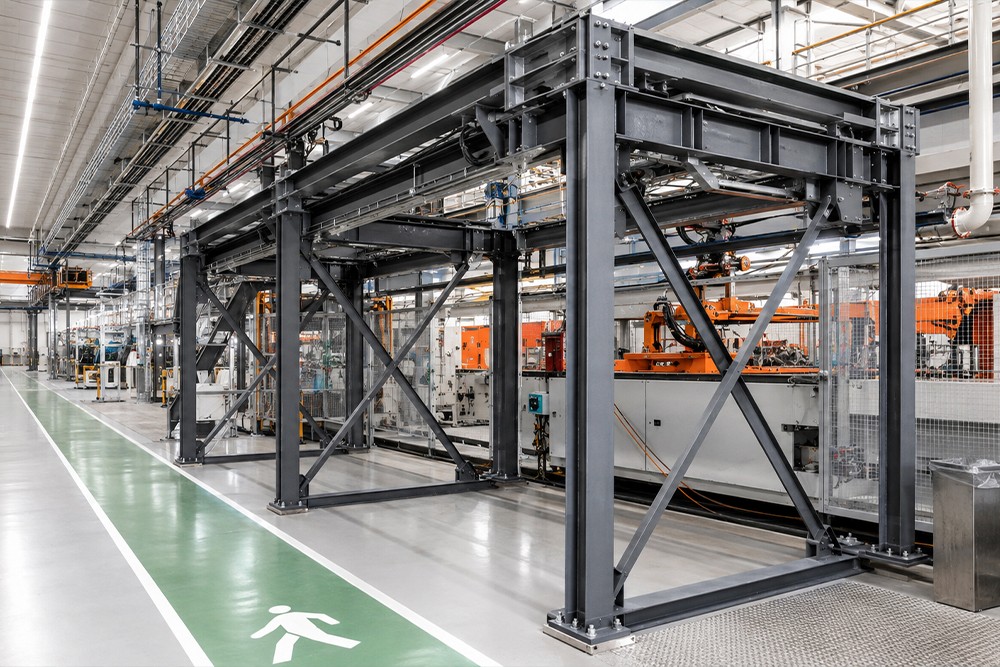
Steel supports are welded or modular structures used to carry machinery, equipment, conveyors, pumps, motors, gearboxes and automation components safely and hold them in the correct position. They transfer static and dynamic loads to the floor, help reduce vibration and deflection and support the preservation of equipment geometry.
Each system is engineered specifically according to equipment weight, operating forces, connection points, floor conditions, maintenance access and handling requirements.
What Is a Steel Support?
A steel support is a structural system that forms the main supporting frame of machinery and equipment, carries loads within a defined geometry and transfers them safely to the floor.
Depending on project requirements, the system may include:
- Box-section, channel or I-beam supports
- Plate and bent-sheet components
- Connection and mounting plates
- Diagonal and horizontal reinforcements
- Feet and base plates
- Forklift pockets
- Lifting lugs
- Anti-vibration mounting points
- Mechanical or chemical anchors
- Modular bolted connections
Advantages of Steel Supports
Transfer Loads Safely
Distribute machine weight, operating forces and equipment loads evenly to the floor.
Reduce Vibration and Deflection Risks
Suitable profile sections, reinforcements and foot positions limit structural deformation.
Support Precise Alignment
Help motors, gearboxes, bearings and motion systems remain positioned within the required geometry.
Facilitate Equipment Installation
Machined mounting plates and hole patterns allow controlled equipment fixing.
Preserve Maintenance and Removal Access
Service openings, removable modules and lifting points support maintenance operations.
Offer a Modifiable Structure
The system can be reinforced, extended or rearranged when capacity or equipment layout changes.
Types of Steel Supports
Fixed Steel Supporting Structures
Rigid systems anchored to the floor to carry equipment continuously in a fixed position.
Mobile Steel Supports
Can be moved within the facility using forklift pockets, lifting lugs or heavy-duty wheels.
Modular Steel Support Systems
Bolted and removable connections facilitate transport, installation and future modifications.
Heavy-Duty Supports
Manufactured with reinforced sections for presses, dies, hydraulic units and heavy equipment.
Precision Equipment Supports
Designed for geometric accuracy and low vibration in CNC, testing, measurement and automation systems.
Conveyor and Line Supports
Custom structures that carry motors, rollers, transfer units and automation equipment on a common frame.
Key Design Considerations
- Static and dynamic loads
- Equipment weight and center of gravity
- Load distribution
- Profile sections and plate thicknesses
- Weld and joint details
- Equipment mounting points
- Vibration isolation
- Floor and anchoring structure
- Handling and lifting method
- Maintenance and removal access
- Corrosion and operating environment
- Future capacity changes
Application Areas
- Machinery manufacturing
- Automotive and supplier industries
- Metalworking facilities
- Food and packaging production
- Plastics and rubber industries
- Energy, pump and compressor systems
- Robotics and automation
- Conveyor and transfer systems
- Presses and hydraulic units
- Defense and special projects
Our Production Process
Each project is evaluated individually according to equipment loads, operating conditions and site connections.
1. Technical Data Analysis and Site Survey
Equipment dimensions, total weight, operating forces, floor, access and connection conditions are evaluated.
2. System Design
Supporting geometry, profile sections, plate components, reinforcements, feet and mounting points are determined. Technical drawings are prepared.
3. Cutting, Machining and Fabrication
Profiles and plates are cut, drilled, bent and machined according to project dimensions.
4. Fixturing, Welding and Inspection
Components are assembled in suitable fixtures. The welding sequence is planned to reduce deformation, and dimensions, flatness and connection centers are inspected.
5. Surface Treatment and Trial Assembly
Blasting, primer, electrostatic powder coating, wet paint or galvanizing is applied. Equipment connections may be checked by trial assembly where required.
6. Shipment and Site Application
The steel support is delivered, positioned, leveled, anchored and finally inspected on site.
Steel Support Modification and Reinforcement
Existing supporting structures may develop cracks, weld damage, corrosion, deflection, loose connections or vibration-related deformation over time. Capacity increases or equipment changes may also make the current system insufficient.
Following a technical inspection, the following works may be carried out:
- Profile and diagonal reinforcement
- Base and mounting-plate renewal
- Foot and anchor modification
- Weld repair
- Support-line extension
- Addition of forklift pockets or lifting lugs
- Modification of equipment mounting points
- Addition of anti-vibration mounting points
- Surface-coating renewal
Material and Surface Options
Material and surface treatment are selected according to load capacity, precision requirements and the operating environment.
Carbon-Steel Profiles
Provide high strength and cost-effective production for general industrial applications.
Plate and Bent-Sheet Components
Used for mounting plates, gussets, base elements and special connections.
Stainless Steel
Can be considered for applications requiring hygiene, chemical resistance or high corrosion protection.
Electrostatic Powder Coating
Provides a durable surface for indoor use and can be matched to corporate colors.
Wet Paint and Industrial Coatings
Suitable for large components or projects requiring special chemical resistance.
Hot-Dip Galvanizing
Provides long-term protection in humid, outdoor or highly corrosive environments.
Why Nevas Çelik?
Projects are not limited to standard profile frames; they are prepared according to equipment loads, operating forces, connection points and site conditions.
Site survey, design, steel fabrication, surface treatment and site application are managed within a single process. In addition to new production, reinforcement, dimensional modification, damage repair and rearrangement of existing supports can also be carried out.
Information Required for a Quotation
- General machinery or equipment dimensions
- Total weight
- Technical drawing or 3D model, if available
- Equipment arrangement on the support
- Connection and mounting points
- Impact, vibration or torque information
- Fixed, mobile or modular use
- Forklift-pocket, lifting-lug or wheel requirements
- Floor and anchoring conditions
- Preferred surface treatment
- Installation and delivery location
Frequently Asked Questions
Are steel supports manufactured in standard dimensions?
No. They are engineered specifically according to machinery dimensions, loads, equipment layout and site conditions.
Can supports be manufactured for heavy machinery?
Yes. Reinforced profile and plate sections can be used according to static and dynamic loads.
Can an existing steel support be reinforced?
Yes. Profile reinforcement, foot renewal, mounting-plate replacement and weld repair can be applied.
Can a forklift-handled system be manufactured?
Yes. Forklift pockets, lifting lugs or heavy-duty wheels can be integrated into the design.
Can special vibration solutions be applied?
Yes. Structural rigidity can be increased and connections can be prepared for anti-vibration mounts or adjustable machine feet.
Do you provide site installation?
Yes. Positioning, leveling, anchoring and final inspection can be included in the project scope.
A Project-Specific Solution for Safe Load Transfer
Technical assessment and project engineering can be provided for a steel-support system suited to machinery and equipment loads, operating conditions and site connections.
You can request a quotation for new production, reinforcement of an existing system or modification based on equipment layout by sharing your project information.