 Türkçe
Welding Tables | Industrial Welding Workbenches
Industrial Welding Tables for Accurate and Efficient Production
Industrial welding tables are production auxiliary systems used to position, secure and join parts accurately and repeatedly during welding and assembly operations. Their rigid work surface, organized clamping points and suitable ergonomics support welding quality, improve cycle organization and help reduce operator strain.
Each table is engineered specifically according to part dimensions, total load, welding method, tolerances, production volume, tabletop configuration, accessory requirements, operator ergonomics and site layout.
What Is an Industrial Welding Table?
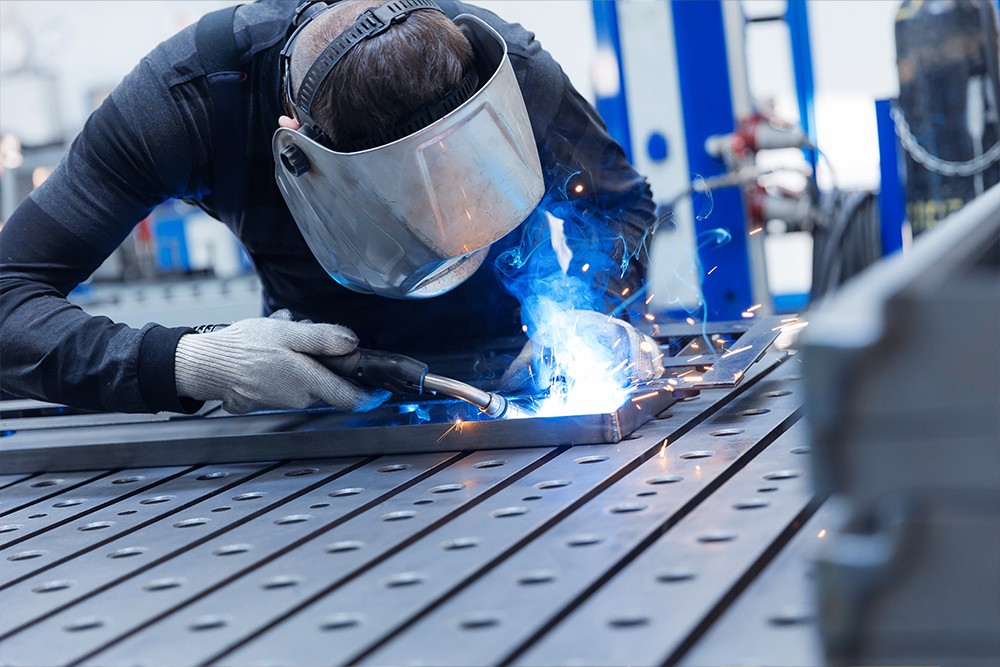
An industrial welding table is a rigid steel work platform used to position, clamp and join metal parts during MIG/MAG, TIG, stick or robotic welding operations.
Depending on project requirements, the system may include:
- Steel-profile supporting frame
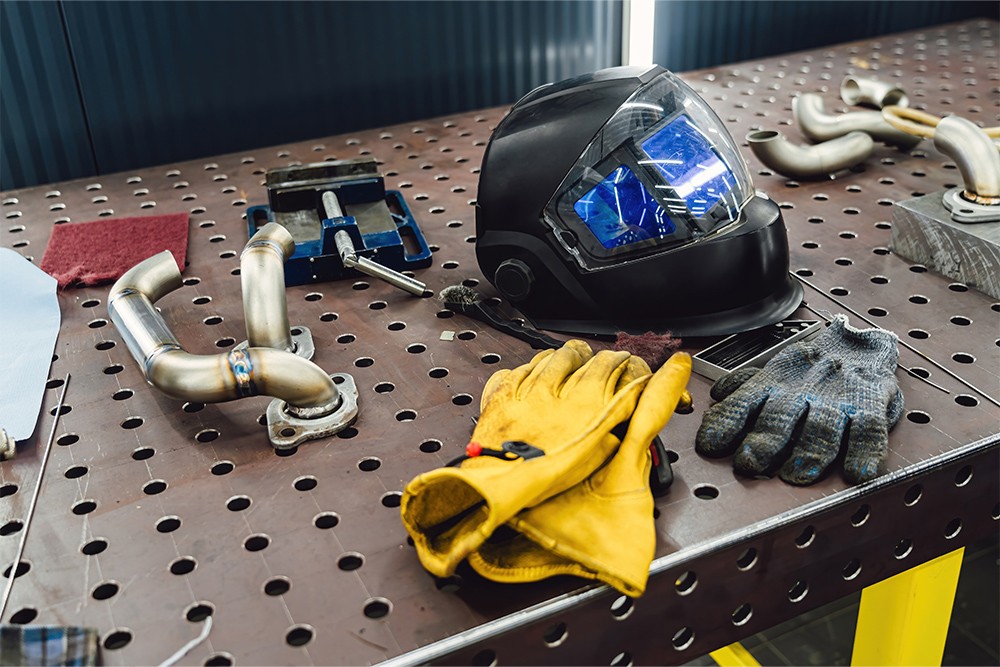
- Flat or precision-machined tabletop
- Perforated or slotted clamping surface
- Modular fixture and accessory locations
- Vises, stops and clamps
- Adjustable feet
- Heavy-duty wheels and brakes
- Shelves, drawers and accessory compartments
- Forklift pockets and lifting lugs
- Robot, positioner and sensor connections
Advantages of Industrial Welding Tables
Provide Accurate Positioning
Help hold parts correctly through defined datum surfaces and clamping points.
Limit Welding Distortion
A rigid tabletop and balanced clamping layout help reduce dimensional and geometric changes caused by heat input.
Reduce Cycle Time
Modular hole and slot patterns simplify fast clamping, removal and repositioning.
Improve Operator Ergonomics
Suitable working height, accessible accessory points and organized table layout reduce physical strain.
Simplify Fixture and Tool Use
Allow vises, stops, clamps and custom fixtures to be used safely in different positions.
Offer a Modular and Upgradeable Structure
New accessories, hole patterns, shelves and modules can be added when products or processes change.
Types of Industrial Welding Tables
Perforated Welding Tables
Provide a flexible work surface for modular clamping components in multiple positions.
Slotted and Modular Welding Tables
Use T-slots or custom channels for rapid positioning of fixtures and clamps.
Heavy-Duty Welding Tables
Manufactured with reinforced frames and thick tabletops for large and heavy components.
Mobile Welding Tables
Can be moved safely within the facility using heavy-duty wheels and braking systems.
Height-Adjustable Welding Tables
Provide mechanical or hydraulic height adjustment for different operators and working positions.
Robotic Welding Tables
Engineered for robot, positioner, sensor and fixture integration within the same station.
Key Design Considerations
- Part dimensions and total load
- Welding method and heat input
- Technical tolerances
- Table dimensions, thickness and flatness
- Hole or slot pattern
- Structural profile sections
- Clamping and datum points
- Operator and robot access
- Working height and ergonomics
- Floor and anchoring conditions
- Mobility and handling requirements
- Accessory and storage layout
Application Areas
- Metalworking and welding workshops
- Automotive and supplier industries
- Machinery manufacturing
- White-goods production
- Robotics and automation lines
- Welded chassis and structural fabrication
- Maintenance and repair workshops
- Prototype and sample production
- Training workshops
- Defense and special projects
Our Production Process
Each project is evaluated individually according to part structure, welding method and operating scenario.
1. Requirements and Technical Data Analysis
Part dimensions, total load, welding method, tolerances, production volume, clamping and accessory requirements are evaluated.
2. System and Ergonomic Design
Table dimensions, tabletop type, working height, hole or slot pattern, accessory layout and operator access are determined.
3. Technical Engineering and Manufacturing
Profiles, tabletop, reinforcements, legs, shelves and connection components are cut, machined and welded according to technical drawings.
4. Surface Treatment and Quality Inspection
Blasting, primer, electrostatic powder coating, wet paint or galvanizing is applied. Dimensions, welds, flatness and connections are inspected.
5. Functional Testing and Trial Assembly
Fixtures, clamping tools, wheels, brakes, adjustable feet and, where applicable, robot or positioner connections are checked.
6. Shipment and Site Handover
The table is delivered safely and handed over after positioning, leveling, anchoring and site-compatibility checks.
Modification and Reinforcement of Existing Welding Tables
Intensive use, impact, overloading, welding heat, corrosion or process changes may require existing welding tables to be modified. Tabletop deflection, cracks, loose connections and dimensional distortion can affect production quality.
Following a technical inspection, the following works may be carried out:
- Reinforcement of the frame and tabletop
- Renewal or replacement of the tabletop surface
- Addition of hole and slot patterns
- Addition of new fixture and accessory connections
- Renewal of legs, wheels and braking systems
- Addition of drawers, shelves and accessory compartments
- Addition of forklift pockets or lifting lugs
- Weld and connection repairs
- Surface-coating renewal
Material and Surface Options
Materials and surface systems are selected according to load capacity, accuracy, operating environment and usage intensity.
Carbon-Steel Profiles
Provide high strength and cost-effective production for the main supporting frame.
Plate and Machined Tabletop Steel
Used for working surfaces, connection plates, reinforcements and special accessory zones.
Stainless Steel
Can be considered for special projects requiring hygiene, humidity resistance or high corrosion protection.
Electrostatic Powder Coating
Provides a durable, cleanable surface for indoor applications and corporate color requirements.
Wet Paint and Industrial Coatings
Can be applied to large components or projects requiring special chemical resistance.
Galvanized Coating
Provides long-term protection in humid, outdoor or highly corrosive conditions.
Why Nevas Çelik?
Projects are not limited to standard table dimensions; they are prepared according to part geometry, total load, welding method, tolerances, ergonomics, clamping layout and site conditions.
Technical design, steel fabrication, precision machining, surface protection, assembly and site handover are managed within a single process. Frame, tabletop, accessory, leg, wheel and surface modifications can also be carried out on existing welding tables.
Information Required for a Quotation
- Dimensions and weights of parts to be welded
- 2D technical drawings or 3D models, if available
- Welding method
- Technical tolerances
- Daily or annual production quantity
- Required table dimensions and working height
- Perforated or slotted tabletop preference
- Fixture and clamping accessories
- Fixed, mobile or adjustable configuration
- Robot or positioner integration
- Preferred surface treatment
- Photographs and dimensions for existing-table modification
Frequently Asked Questions
Which materials are welding tables made from?
They are generally manufactured from steel box profiles, U-sections, I-sections and steel plate selected in suitable thicknesses.
Are welding tables manufactured in standard dimensions?
No. They are produced specifically according to part dimensions, load, tolerances, welding method and site layout.
Can perforated or slotted tabletops be manufactured?
Yes. Hole or slot patterns can be prepared according to the fixtures and clamping equipment to be used.
Can mobile welding tables be manufactured?
Yes. Heavy-duty wheels, brakes and required safety details can be integrated.
Can a table be designed for a robotic welding cell?
Yes. Robot access, positioners, sensors, fixtures and cable infrastructure can be considered in the design.
Can an existing welding table be reinforced?
Yes. The frame, tabletop, legs, connections, accessories and surfaces can be modified following technical inspection.
A Project-Specific Solution for Accurate Welding Operations
Technical assessment and project engineering can be provided for a welding table suited to your part dimensions, welding method, tolerances and production layout.
You can request a quotation for a new welding table, reinforcement of an existing table or tabletop, accessory, leg and mobility modifications by sharing your project information.