 Türkçe
WIP Racking Systems | In-Process Inventory Racks
Industrial WIP Racking Systems for Organized and Controlled Production Flow
WIP racking systems are intermediate-storage solutions used to hold semi-finished products, components, crates, fixtures and subassemblies safely and accessibly while they wait for the next production step. They reduce line-side clutter, make stock levels visible and organize material flow between workstations.
Each system is engineered specifically according to part dimensions, load capacity, cycle time, target WIP quantity, feeding method, operator ergonomics and site layout.
What Is a WIP Racking System?
A WIP racking system is an industrial storage system in which unfinished products and components are held in defined rack bays, flow lanes, drawers or custom cradles before moving to the next operation.
Depending on project requirements, the system may include:
- Steel-profile supporting frame
- Adjustable rack levels
- Sheet-metal or grating shelves
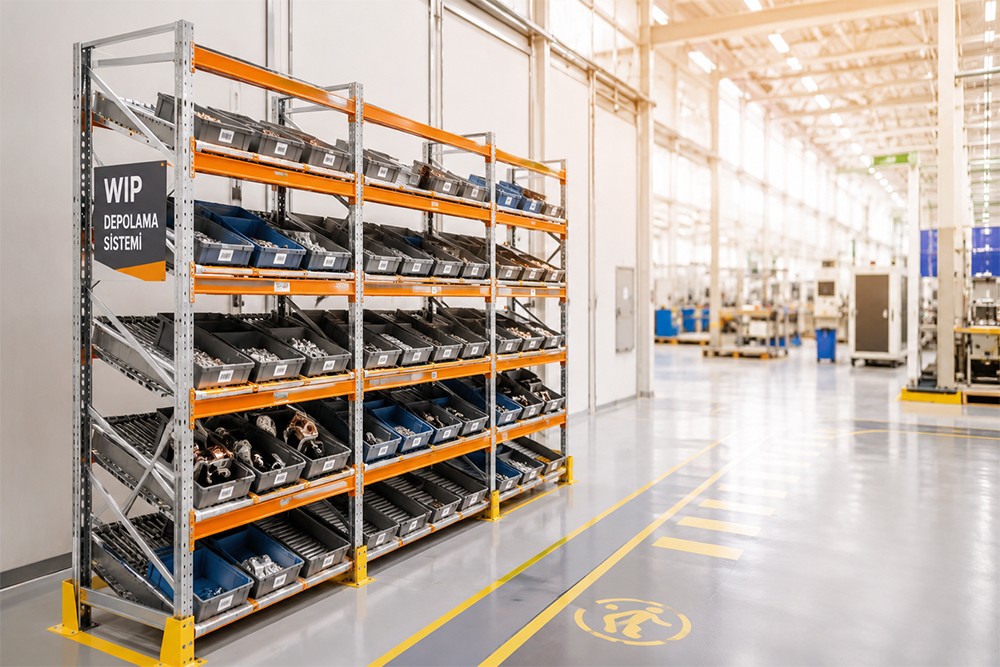
- Inclined roller flow lanes
- Separators and custom part cradles
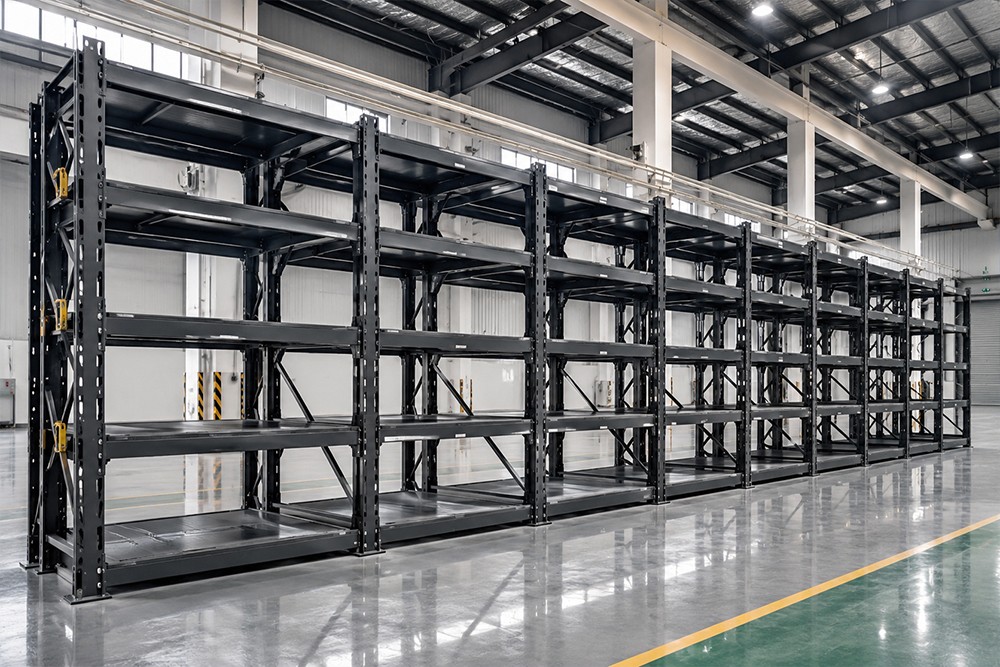
- Pull-out drawer modules
- Crate and box lanes
- Stops and fall-prevention elements
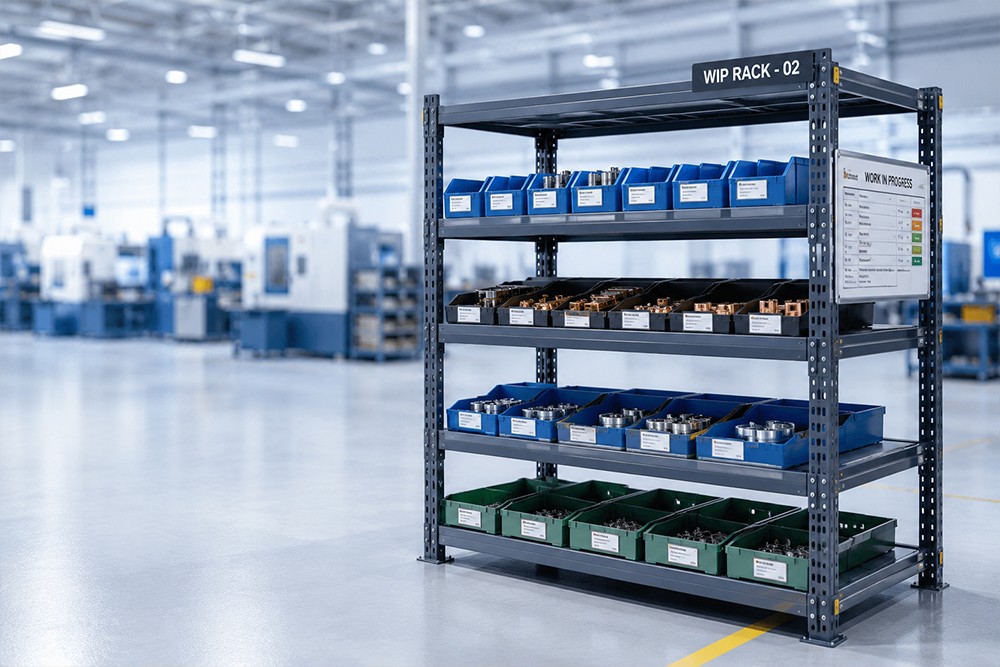
- Label pockets and Kanban areas
- Fixed, mobile or anchored frame options
Advantages of WIP Racking Systems
Organize Work-in-Process Inventory
Keep semi-finished products, crates and subassemblies in defined rack locations.
Support Production Flow
Ensure materials remain ready and accessible for the next operation.
Support FIFO and Kanban Applications
Use inclined flow lanes, visible stock levels and labeling areas for controlled feeding.
Reduce Part Mix-Ups
Separated compartments by product code, operation or batch help prevent incorrect part use.
Help Protect Products
Separators, coated surfaces, cradles and stops reduce contact, scratching and falling risks.
Offer a Modular and Expandable Structure
Rack levels, compartments and accessories can be rearranged when products or production plans change.
Types of WIP Racking Systems
Line-Side WIP Racks
Positioned next to production and assembly stations for quick operator access.
FIFO Flow Racks
Allow crates and boxes to move from the loading side to the picking side on inclined roller lanes.
Adjustable-Level WIP Racks
Rack levels can be repositioned to accommodate different product heights.
Pull-Out WIP Racks
Provide controlled access to heavy parts, fixtures and components.
Separated and Custom-Cradle Racks
Prepared for sensitive, painted or specially shaped parts that must not contact one another.
Mobile and Heavy-Duty WIP Racks
Can be produced on wheeled frames or reinforced for heavy semi-finished products.
Key Design Considerations
- Part, crate and box dimensions
- Maximum load per level and bay
- Target WIP quantity
- Cycle time and feeding frequency
- Loading and unloading direction
- FIFO or Kanban requirements
- Rack depth and level spacing
- Operator reach height
- Separators, cradles and surface protection
- Labeling and visual-management areas
- Pedestrian and forklift routes
- Future product changes
Application Areas
- Automotive and supplier industries
- Metalworking facilities
- Plastic injection and die manufacturing
- Machinery manufacturing
- White-goods and electronics production
- Food and packaging facilities
- Production and assembly lines
- Warehouses and logistics areas
- Defense and energy sectors
- Custom production and process lines
Our Production Process
Each project is evaluated individually according to WIP quantity, product flow and site conditions.
1. Requirements Analysis and Site Survey
Product groups, part dimensions, loads, cycle times, stock quantities, feeding method and site layout are evaluated.
2. Flow and System Design
Entry-exit directions, rack bays, level spacing, flow lanes, separators, labeling areas and reach levels are determined.
3. Manufacturing
Steel profiles, sheets, shelves, drawers, rollers and connection components are cut, bent and assembled according to project dimensions.
4. Surface Treatment and Quality Inspection
Electrostatic powder coating, wet paint, galvanizing or protective coating is applied. Dimensions, welds, connections and flow surfaces are inspected.
5. Testing and Functional Inspection
Rack levels, drawers, roller lanes, stops, product movement, labeling areas and operator access are tested.
6. Shipment and Site Installation
The system is delivered, aligned and anchored; accessory installation and final use checks are completed.
Modification and Expansion of Existing WIP Racks
Changes in product dimensions, production plans or line layouts may make existing WIP racks insufficient. Intensive use may also cause shelf deformation, loose connections, wheel failures or surface damage.
Following a technical inspection, the following works may be carried out:
- Addition of new rack levels or bays
- Separator and custom-cradle modification
- Addition of FIFO flow lanes
- Drawer and shelf renewal
- Supporting-frame reinforcement
- Wheel and braking-system replacement
- Addition of labeling and Kanban areas
- Dimensional and capacity modification
- Surface-coating renewal
Material and Surface Options
Material and surface treatment are selected according to load capacity, product sensitivity and operating environment.
Carbon-Steel Profiles
Provide a durable and cost-effective solution for uprights, beams, frames and supports.
Sheet and Bent-Metal Components
Used for shelves, separators, drawers, stops, label pockets and protective panels.
Roller and Plastic Slide Systems
Allow low-friction product movement in FIFO and controlled-flow applications.
Protective Surfaces
Rubber, plastic, felt and similar coverings help protect sensitive parts.
Electrostatic Powder and Wet Paint
Provide durable surfaces for indoor use and applications requiring specific chemical resistance.
Galvanized Coating
Provides long-term protection in humid, semi-open or highly corrosive environments.
Why Nevas Çelik?
Projects are not limited to standard rack dimensions; they are prepared according to actual part sizes, target WIP quantity, cycle time, flow direction, operator access and site conditions.
Site survey, technical design, steel fabrication, surface treatment and site installation are managed within a single process. Reinforcement, flow-lane addition, level adjustment and capacity increase can also be carried out on existing WIP racks.
Information Required for a Quotation
- Photographs of semi-finished products or parts
- Part, crate and box dimensions
- Maximum weight per product or crate
- Target WIP quantity
- Production-line or layout plan
- Loading and unloading direction
- FIFO, Kanban or flow-rack requirements
- Rack-level, separator and drawer requirements
- Floor and installation conditions
- Preferred surface treatment and color
- Installation and delivery location
Frequently Asked Questions
What is a WIP racking system used for?
It holds semi-finished products, components, crates and subassemblies in an organized and controlled manner until the next operation.
Are WIP racks manufactured in standard dimensions?
No. Rack bays, level spacing, capacity and accessories are prepared specifically according to the product and site conditions.
Can FIFO flow racks be manufactured?
Yes. Inclined roller lanes, stops and separate loading-picking directions can be designed for crates and boxes.
Can custom cradles be manufactured for sensitive parts?
Yes. Sheet-metal, plastic, rubber or felt-supported cradles and separators can be produced according to part geometry.
Can mobile WIP racks be manufactured?
Yes. Wheeled, braked or towable systems can be prepared according to load capacity and floor conditions.
Can existing racks be converted into WIP systems?
Yes. After a suitability assessment, rack levels, separators, flow lanes, labeling areas and drawers can be added.
A Project-Specific Solution for Controlled WIP and Continuous Production
Technical assessment and project engineering can be provided for a WIP racking system suited to your product dimensions, WIP quantity and production flow.
You can request a quotation for a new system, modification of existing racks or FIFO and Kanban integration by sharing your project information.