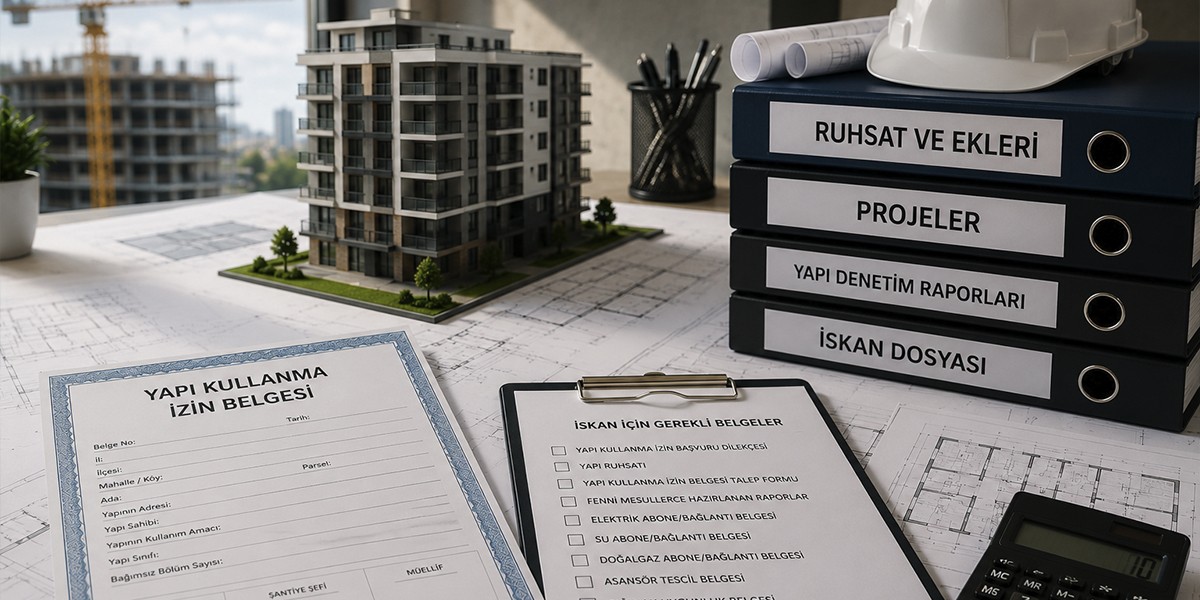
Upon completion of a building or the parts thereof that can be partially utilized, it is mandatory to obtain a permit from the relevant authority upon application by the property owner. This permit is referred to as the Building Occupancy Permit or Occupancy Permit (İskan Belgesi).
Buildings with a Building Occupancy Permit are understood to have been constructed in accordance with the project plans and legislation. Infrastructure utility subscriptions for buildings—such as electricity, water, natural gas, and telephone—can only be established provided they possess an occupancy permit. Structures without an occupancy permit are not permitted to benefit from such services.
When a building is completed according to its building permit and approved project attachments, the consent or approval of all plot owners is not required for the issuance of the building occupancy permit; an application and signature by a single owner for occupancy is sufficient (Planned Areas Zoning Regulation, Article 64, Paragraph 11).
An important consideration during the issuance stage of a Building Occupancy Permit is the condition of partial occupancy. It is not necessary for all permitted structures or every independent unit within a single building to obtain an occupancy permit simultaneously. An occupancy permit can be requested and issued solely for the completed sections. If only 1 (one) independent section of a building consisting of 10 (ten) independent sections is completed and ready for use, an occupancy permit can be obtained for that section alone.
The crucial point to consider during partial occupancy applications and permit drafting is that the common areas of the structure must be fully completed. If a building is to receive partial occupancy, construction work concerning the entire building—such as an operational elevator, a functional parking area, completed landscaping, an accessible shelter, built perimeter walls, and installed stair handrails—must be fully finished. Obtaining a partial occupancy permit implies that the building's common areas are completely ready for use.
One of the most significant challenges encountered during the Building Occupancy Permit phase is the refusal of building contractors, site managers, or project designers to sign the document for various reasons. Generally, withholding a signature is used as leverage by the contractor, site manager, or designer to enforce financial demands, whether justified or unjustified. Article 28, Paragraph 10 of the Zoning Law No. 3194 states: "For buildings whose completion has been verified through architectural and engineering inspection reports prepared by technical officers, as well as a determination record jointly drawn up by the property owner, technical officers, and staff of the relevant administration, but where occupancy permit procedures cannot be finalized due to the building contractor's failure to fulfill tax and social security premium obligations or other responsibilities arising from construction work, the building occupancy permit shall be issued by the relevant administration upon determination of the situation, based on the request of the property owner who is not the building contractor.
A copy of this permit shall be sent to the relevant professional chambers and the Ministry to be recorded and evaluated in the records of the institutions and individuals concerned." The key section to note in this paragraph is: "...for buildings where occupancy permit procedures cannot be finalized due to the building contractor's failure to fulfill tax and social security premium obligations or other responsibilities arising from construction work, the building occupancy permit shall be issued by the relevant administration upon determination of the situation, based on the request of the property owner who is not the building contractor..."
Signing the Building Occupancy Permit is among the responsibilities of the site manager, contractor, and project designers. According to this paragraph, if the building contractor fails to fulfill their obligations—meaning they do not sign the Building Occupancy Permit despite being required to do so, or if the contractor cannot be reached—the relevant administration (Municipality) must attach the documents showing that the building was constructed in accordance with the permit and its attachments, or the documents demonstrating/proving that the contractor cannot be located, along with the contract between the contractor and property owner to the file, state the reason for the missing signature in the section reserved for the contractor's signature on the permit, and issue the building occupancy permit without the building contractor's signature.
 Türkçe