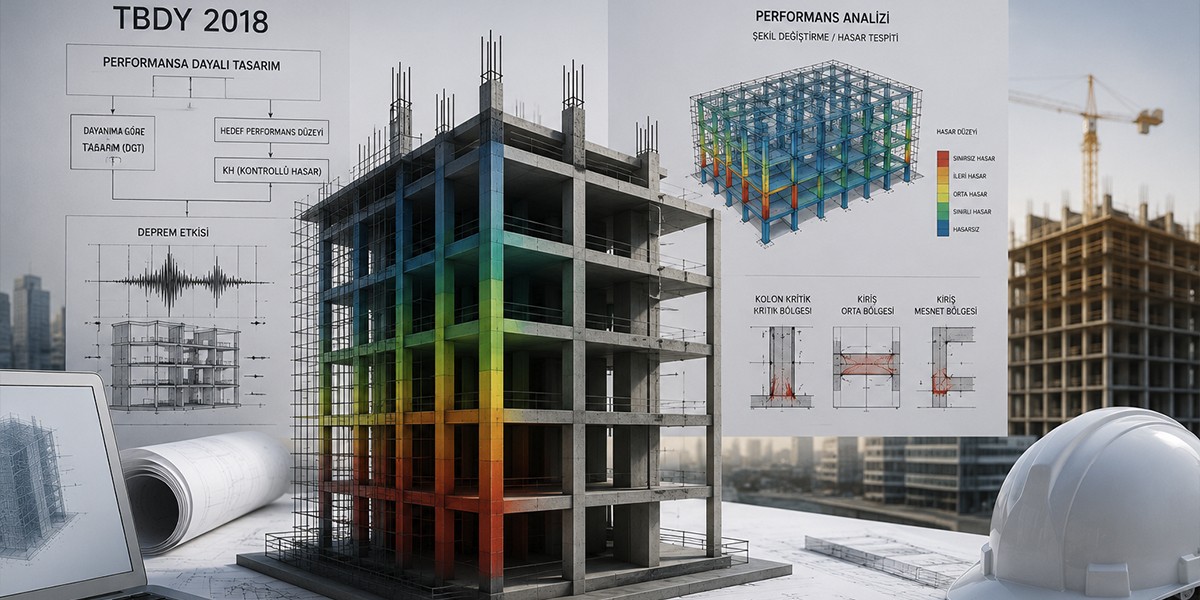
The TBDY 2018 Code states in Article 3.4 and onwards that it is a performance-based regulation, specifying which performance level buildings must provide during a corresponding earthquake. For new buildings to be constructed, Controlled Damage (KH) is specified as the normal performance target, and Design Based on Strength (DGT), i.e., linear analysis, is prescribed as the calculation technique.
Performance analysis is the determination of which column, which beam, and exactly where in which column or beam damage will occur during a potential or design earthquake. Considering that damage technically means deformation, performance analysis essentially means calculating strain/deformations at the critical points of structural elements. In a reinforced concrete structure, calculating the compressive strain in concrete and the tensile strain in steel within column and beam elements constitutes performance analysis.
Chapter 4 of TBDY 2018 specifies the principles of Design Based on Strength for Buildings Under Earthquake Effects. New structures are designed according to this chapter. When designing based on strength, deformations in structural elements (elongation in reinforcement, shortening in concrete) are not calculated. There are a set of limit force/stress values, and comparison is made against those evaluations as a result of the calculation. When considered in detail, and keeping in mind that deformations/damage must be known for a performance-based calculation, it can be said that this type of calculation contradicts the main philosophy of the code, which is performance-based design.
Chapter 4 of TBDY 2018 states that when new buildings are designed based on strength and the principles in this chapter are complied with, the structure will achieve the Controlled Damage (KH) performance level, providing this guarantee to the engineer without requiring deformation-based calculations.
There is no need to perform an additional performance analysis for new buildings designed according to this chapter. On the other hand, Chapter 15 of TBDY 2018 covers the evaluation and retrofitting of existing buildings. Calculating or evaluating a newly planned building as if it were an existing structure based on Chapter 15 is an unnecessary practice.
The calculation criteria in Chapter 15, particularly the deformation-based criteria, differ from those in Chapter 4. The same result cannot be expected—nor should it be expected—from techniques whose criteria and underlying fundamentals are different.
In this context, it is mandatory to comply with the relevant chapters of TBDY 2018 regarding structures. Whether a building is existing, newly to be constructed, or to be retrofitted, it is sufficient to base calculations solely on the corresponding chapter of the code. Re-classifying a newly planned building designed based on strength as an existing building and attempting to apply Chapter 15 requirements is nothing more than a waste of time.
In conclusion, a new structure designed based on strength according to the principles in Chapter 4 of TBDY 2018 is deemed to have met the Controlled Damage (KH) performance level, and the code itself guarantees this to the engineer.
 Türkçe